

What Is Agni in Ayurveda? Understanding the Digestive Fire
Imagine preparing a nourishing meal with fresh vegetables, wholesome grains, and healing spices—but without lighting the fire. The ingredients may be excellent, yet transformation cannot happen.
According to Ayurveda, Agni represents the transformative power that enables the body to digest, assimilate, and utilize what we consume. Often described as the digestive fire, Agni is central to the Ayurvedic understanding of digestion, nourishment, vitality, and overall well-being.
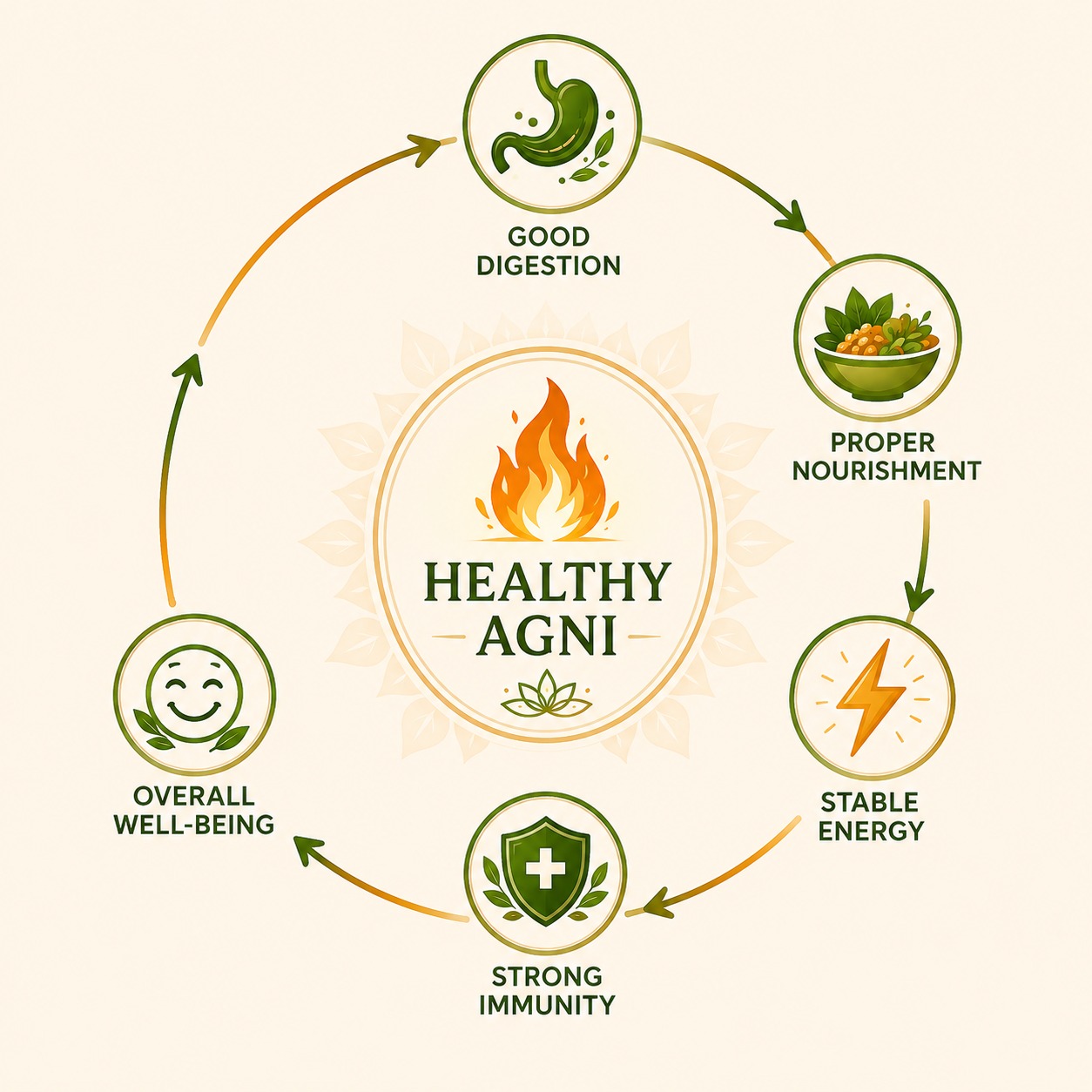
When Agni is balanced, digestion can function smoothly and nourishment can be properly supported. When Agni is disturbed, digestion and overall balance may be affected.
Understanding Agni therefore means looking beyond what we eat to also consider how well we digest and assimilate it.
What Is Agni ?
In Ayurveda, Agni refers to the body’s capacity for digestion and transformation. It is not limited to the physical breakdown of food; Ayurveda describes Agni as the force through which nourishment is processed, assimilated, and made available to support the body.
At the level of digestion, Agni helps transform food into nutrients that can be utilized by the tissues. Ayurveda also associates balanced Agni with strength, vitality, clarity, and overall well-being.
Agni is therefore closely connected with Ayurvedic digestion and nourishment. When it functions appropriately, digestion and assimilation are supported. When it becomes irregular, weak, or excessive, digestive balance may be disturbed.
Why Agni Matters in Ayurveda
Ayurveda places Agni at the heart of health because digestion is closely connected with nourishment, strength, and balance.
When Agni functions appropriately, food can be digested and assimilated effectively, supporting the nourishment of the body. When Agni becomes weak, irregular, or excessive, Ayurveda describes corresponding disturbances in digestion and overall well-being.
This is why Ayurvedic traditions place such importance on protecting and maintaining balanced Agni—not through complicated rules, but through appropriate food, regular routines, mindful eating, adequate rest, and practices suited to the individual.
Agni and Ayurvedic Health
Agni connects what we consume with how the body receives and utilizes nourishment. It is therefore closely associated with digestion, assimilation, metabolism, strength, and vitality within the Ayurvedic framework.
A balanced Agni is not necessarily the strongest or most intense Agni. Rather, Ayurveda emphasizes Samagni—a steady and balanced digestive function appropriate to the individual.
Understanding this distinction helps us appreciate why Ayurveda looks beyond food alone when considering digestion and nourishment.
Agni is not simply about how strongly we digest. It is about how well the process remains balanced.
Why Agni Matters Beyond What You Eat
Eating nutritious food is important, but Ayurveda looks beyond the quality of food to the body’s ability to digest and assimilate it.
Two people may eat the same meal and experience it differently. Ayurveda therefore considers Agni, appetite, digestion, meal timing, and individual constitution when understanding how food supports the body.
This is why Ayurveda emphasizes not only what we eat, but also how, when, and how well we digest it.
Food Becomes Nourishment Through Digestion
According to Ayurveda, properly functioning Agni helps transform food into nourishment that can be utilized by the body. When digestion is disturbed, the body may not process food as effectively, even when the food itself is wholesome.
This does not mean that food quality is unimportant. Rather, Ayurveda views food and digestive capacity as interconnected.
Supporting healthy Agni therefore begins with simple practices such as eating according to genuine hunger, avoiding habitual overeating, allowing adequate time between meals, and paying attention to how different foods affect your digestion.
In Ayurveda, nourishment begins not only with what is on the plate, but with the way the body receives and processes it.
The Agni Cycle of Health A healthy digestive fire creates a positive cycle...
Explore the Ayurvedic connection between Agni and Ojas, the essence associated with vitality and resilience.
The Four Types of Agni in Ayurveda
Ayurveda describes four primary patterns of digestive Agni. These patterns can be influenced by Doshas, food, lifestyle, routine, season, and individual factors.
| Type of Agni | Meaning | Predominant Ayurvedic Association |
|---|---|---|
| Samagni | Balanced and steady | Balanced state |
| Mandagni | Slow or weak digestion | Kapha |
| Tikshnagni | Sharp or intense digestion | Pitta |
| Vishamagni | Irregular or variable digestion | Vata |
Samagni — Balanced Agni
Samagni represents balanced and steady digestive function.
Ayurveda associates balanced Agni with comfortable digestion, regular elimination, stable energy, restful sleep, and mental clarity.
In Ayurveda, Samagni is considered the desirable state of Agni because it reflects digestive balance.
Mandagni — Slow Agni
Mandagni refers to sluggish or weak digestive activity. Appetite may be reduced, and meals may feel heavy or slow to digest.
Commonly described signs include:
- Feeling heavy after meals
- Bloating or digestive discomfort
- Reduced appetite
- Sleepiness after eating
Ayurveda traditionally associates Mandagni predominantly with Kapha Dosha, whose qualities include heaviness, slowness, and stability.
Tikshnagni — Sharp Agni
Tikshnagni refers to an unusually intense digestive state. Appetite may be strong, and hunger may return quickly after meals.
Commonly described experiences may include:
Strong or frequent hunger
Burning or acidic digestive sensations
Irritability when meals are delayed
Loose stools
Ayurveda traditionally associates Tikshnagni predominantly with Pitta Dosha, whose qualities include heat and intensity.
Vishamagni — Irregular Agni
Vishamagni refers to variable or unpredictable digestive function. Appetite and digestive comfort may fluctuate rather than following a consistent pattern.
Commonly described experiences may include:
Irregular appetite
Gas or abdominal discomfort
Constipation
Variable digestion
Ayurveda traditionally associates Vishamagni predominantly with Vata Dosha, whose mobile and irregular qualities are reflected in this variable digestive pattern.
Agni and the Doshas
These associations help explain why Ayurveda considers digestion in relation to an individual’s constitution and current state of balance.
They should not be understood as rigid categories in which one Dosha always produces one type of Agni. Agni can change with season, diet, lifestyle, age, stress, and other influences.
The Ayurvedic aim is not to make Agni excessively strong, but to support balanced Agni appropriate to the individual.
Agni and Your Prakriti
Everyone has Agni, but its expression can vary according to an individual’s Deha Prakriti (constitutional nature). Ayurveda traditionally associates Vata predominance with a tendency toward Vishama Agni, Pitta with Tikshna Agni, and Kapha with Mandagni.
These are tendencies, not fixed rules. Agni can also change according to an individual’s circumstances and current state of balance.
Understanding your Prakriti can provide a useful Ayurvedic perspective on your individual digestive tendencies and overall well-being.
Learn more about Deha Prakriti and explore your Ayurvedic constitution.
What Is Your Agni Telling You?
Your digestion can offer useful clues about your daily habits and how your body responds to food. Ayurveda encourages observing these patterns rather than treating a single symptom as a diagnosis.
Consider these questions:
Is your appetite generally steady?
Do you feel comfortable after meals?
Does your digestion feel slow or heavy?
Does hunger return unusually quickly?
Does your appetite or digestion vary from day to day?
Do certain foods consistently affect your digestive comfort?
These observations may help you recognize patterns associated with Samagni, Mandagni, Tikshnagni, or Vishamagni within the Ayurvedic framework.
A Simple Ayurvedic Reflection
Instead of asking, “What is wrong with my digestion?”, begin with:
“What patterns is my digestion showing me?”
Notice your appetite, comfort after meals, bowel habits, and energy across several days rather than drawing conclusions from one experience.
This kind of mindful observation can be a simple first step toward understanding your Agni and individual digestive tendencies.
What Weakens Agni?
According to Ayurveda, Agni can become disturbed when food, lifestyle, routine, and daily habits are not well suited to the individual.
Common factors traditionally associated with disturbed Agni include:
Eating without genuine hunger
Overeating or eating too frequently
Irregular meal times
Heavy or difficult-to-digest meals
Excessive intake of very cold foods or drinks
Eating too quickly or without attention
Stress and emotional strain
Insufficient or irregular sleep
Sudden changes in routine
These factors do not affect everyone in the same way. Ayurveda considers the individual’s Prakriti, current state of balance, and digestive capacity when understanding Agni.
A Simple Principle
Rather than following rigid food rules, Ayurveda encourages observing how your body responds.
Eat with awareness. Eat according to genuine hunger. Give digestion adequate time. Notice what supports comfort and what repeatedly disturbs it.
Small, consistent adjustments to food and routine may help support balanced Agni.
Explore the Ayurvedic concept of Ama and its connection with disturbed digestion.
Understanding Ama in Ayurveda
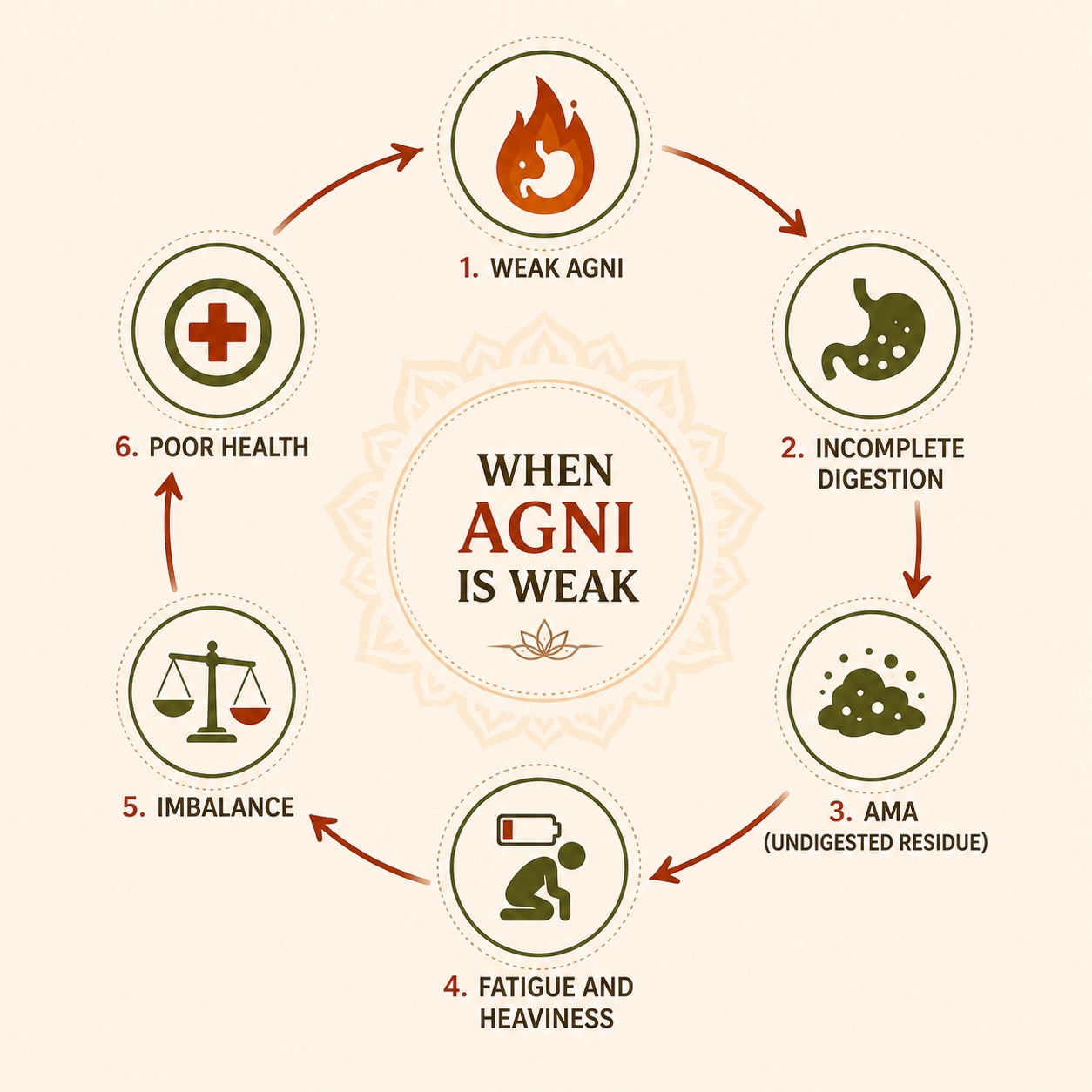
In Ayurveda, Ama is a traditional concept associated with impaired or incomplete digestion and metabolism. It is often described as a residue that may arise when Agni is unable to properly process what is consumed.
Ama is therefore closely connected with the Ayurvedic understanding of Agni and digestion. When digestion is disturbed, Ayurveda considers the accumulation of Ama as one possible consequence.
How Ayurveda Describes Ama
Ayurvedic texts associate Ama with qualities such as heaviness, stickiness, and impaired movement within the body. It is traditionally discussed in relation to digestive imbalance and the disruption of normal physiological processes.
Common experiences that Ayurveda may associate with Ama include:
Feeling heavy or sluggish
Reduced appetite
Coated tongue
Digestive discomfort
Bloating or a sense of fullness
Low energy
These experiences are not specific diagnostic signs of Ama and can have many causes. In Ayurveda, they are considered together with an individual’s digestion, Dosha balance, lifestyle, and overall pattern.
Agni and Ama: The Ayurvedic Connection
In simple Ayurvedic terms:
Balanced Agni → effective digestion and nourishment
Disturbed Agni → impaired digestion → Ama may develop
This relationship is one reason Ayurveda places such importance on maintaining balanced Agni.
7 Simple Ways to Support Balanced Agni
Ayurveda focuses on maintaining balanced Agni, rather than making digestion excessively strong. Simple, consistent habits can support comfortable digestion and a healthy daily rhythm.
1. Eat According to Genuine Hunger
Allow appetite to guide your meals rather than eating simply because it is a habitual mealtime. Avoid repeatedly eating when you are already full.
2. Keep Meals Regular
A reasonably consistent meal routine can help establish a predictable rhythm for digestion. Avoid constantly changing meal times or grazing throughout the day.
3. Choose Fresh, Suitable Foods
Prefer fresh, wholesome foods that are appropriate for your Prakriti, season, appetite, and digestive capacity. Ayurveda emphasizes suitability rather than a single diet that works for everyone.
4. Eat Mindfully
Eat slowly, chew thoroughly, and give your meal your attention. Avoid regularly eating while distracted, rushed, or emotionally overwhelmed.
5. Avoid Habitual Overeating
Large or heavy meals may be difficult to digest for some people. Eating comfortably rather than excessively can support digestive ease.
6. Give Digestion Time
Allow adequate time between meals rather than continuously adding food before the previous meal has been comfortably digested.
7. Support a Consistent Daily Routine
Adequate rest, regular sleep, appropriate movement, and a stable daily rhythm can complement healthy digestion and overall well-being.
The Ayurvedic principle is simple: support your digestion consistently rather than trying to force it.
Yoga Practices That Support Agni
Yoga can complement Ayurvedic routines by supporting movement, relaxation, body awareness, and digestive comfort. Ayurveda and Yoga share an emphasis on maintaining balance rather than forcing the body into extremes.
The following practices may be incorporated into a suitable personal practice:
Vajrasana — After Meals
Sitting quietly in Vajrasana after a meal is a traditional practice often associated with supporting comfortable digestion. It also provides a simple transition from eating to rest.
Cat-Cow — Gentle Movement
Cat-Cow (Marjaryasana–Bitilasana) gently moves the spine and abdomen and can help create awareness around the breath and body.
Seated Twist
A gentle seated spinal twist can encourage mindful movement around the abdomen and may support digestive comfort.
Apanasana — Knees to Chest
Apanasana is a gentle posture traditionally included in practices aimed at relaxation and abdominal comfort. Move slowly and comfortably without forcing the posture.
Surya Namaskar — Whole-Body Practice
Surya Namaskar (Sun Salutations) combines movement and breath and can support circulation, mobility, and overall vitality when practiced appropriately.
Gentle Breathing
Slow, comfortable breathing can help settle the nervous system and encourage relaxation. Practices should be adapted to the individual’s experience and taught appropriately when technique is unfamiliar.
Yoga is not a treatment for digestive disorders. If you experience persistent, severe, or concerning digestive symptoms, seek appropriate medical advice.
Ready to Put Ayurveda into Practice?
Understanding Agni is the first step. The next is learning how to observe your digestion and build simple, sustainable habits that support your individual needs. Start with small changes:- Notice your appetite and digestive comfort.
- Eat mindfully and avoid habitual overeating.
- Follow a consistent daily rhythm.
- Include suitable movement and Yoga.
- Observe what supports your well-being over time.
Need Personalized Ayurvedic Guidance?
Understanding Agni can help you observe your digestive patterns, but individual needs can vary.
If you have persistent digestive concerns or would like personalized Ayurvedic guidance based on your constitution, lifestyle, and individual needs, consider speaking with an Ayurvedic practitioner.
Continue Your Ayurveda Journey
If you enjoyed exploring Agni, continue your journey through these related Ayurveda guides:
Understanding Vata, Pitta, and Kapha — Explore the three Doshas and how they influence individual balance.
Dinacharya: The Ayurvedic Daily Routine — Discover simple Ayurvedic principles for creating a balanced daily rhythm.
Ayurveda for Modern Life — Explore how Ayurvedic wisdom can be applied to contemporary living.
Your Digestive Fire Shapes More Than Your Meals
Every day, your body communicates through appetite, digestion, energy, and vitality.
Ayurveda invites us to listen—to observe our patterns, understand our individual needs, and support balanced Agni through mindful choices and daily practice.
Agni is more than the digestion of food. In the Ayurvedic understanding, it represents a deeper principle of transformation—how what we take in is processed, transformed, and ultimately becomes part of our experience of nourishment and well-being.
The goal is not to make Agni stronger, but to support it in balance.
At Ayuryogaheal, we believe health begins with awareness, grows through daily practice, and flourishes through balance.
One mindful observation. One small practice. One step closer to living in harmony with body and mind.