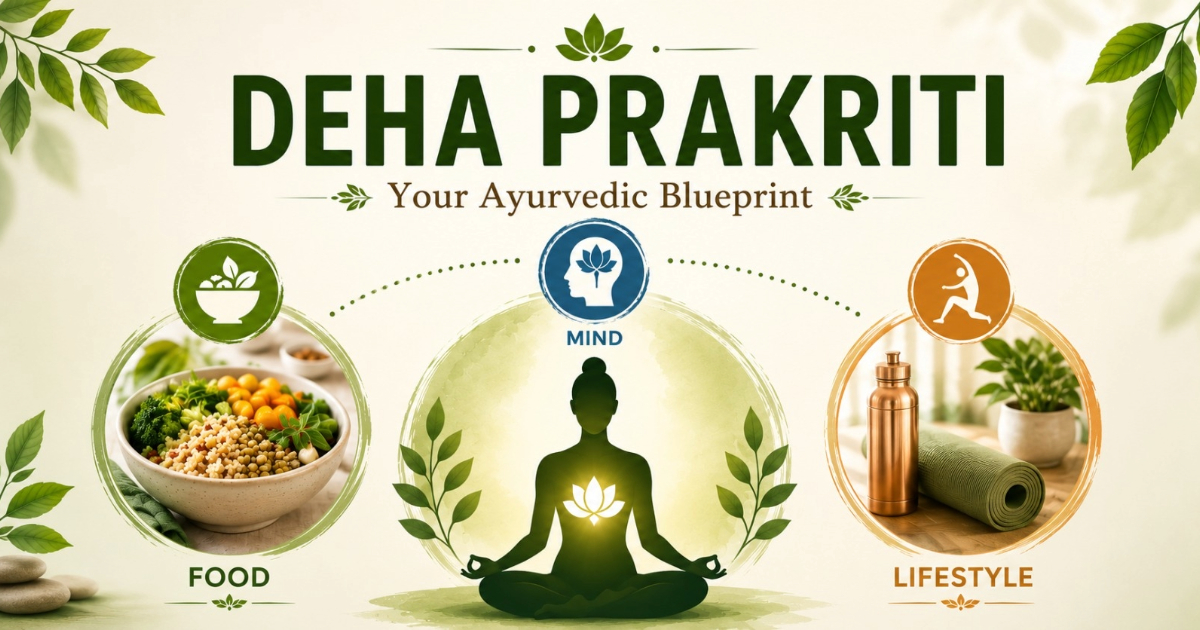
What Is Deha Prakriti? Understanding Your Ayurvedic Constitution
No two leaves on a tree are exactly alike.
They may grow on the same branch, receive the same sunlight, and be nourished by the same soil—yet each has its own shape, colour, and character.
Ayurveda views human beings in much the same way.
While we all share the same basic needs for food, rest, movement, and emotional well-being, the way each of us responds to these experiences can be uniquely our own. The meal that leaves one person feeling light and energized may leave another feeling heavy. A daily routine that helps one individual flourish may not suit someone else.
Rather than asking, “What is the best lifestyle?” Ayurveda first asks a different question:
“What is naturally suited to you?”
The answer begins with Deha Prakriti—the Ayurvedic concept of individual constitution.
Understanding Deha Prakriti is not about fitting yourself into a rigid category. It is about recognizing your natural constitutional tendencies and understanding how they may relate to the way you experience food, activity, rest, stress, and everyday life.
Table of Contents
- What Is Deha Prakriti?
- Why Deha Prakriti Matters
- How Vata, Pitta and Kapha Shape Prakriti
- Recognizing Constitutional Tendencies
- How Does Deha Prakriti Relate to Food and Digestion?
- How Does Deha Prakriti Relate to the Mind and Stress?
- How Can Deha Prakriti Inform Everyday Lifestyle?
- Can Your Prakriti Change?
- Frequently Asked Questions
Quick Answer: What Is Deha Prakriti?
Deha Prakriti is your natural Ayurvedic constitution—the individual pattern of tendencies established early in life.
Ayurveda describes this constitution through the three Doshas: Vata, Pitta, and Kapha, in different proportions.
In simple terms, Deha Prakriti provides a framework for understanding why people may respond differently to food, activity, rest, stress, seasons, and other aspects of everyday life.
It is not meant to place you into a rigid category. Rather, understanding your Prakriti can help you appreciate your natural tendencies and make more individualized, conscious choices about daily living.
What Does Deha Prakriti Mean?
The term Deha Prakriti combines two Sanskrit words:
Deha means body.
Prakriti refers to one’s natural constitution, inherent nature, or constitutional pattern.
Together, Deha Prakriti refers to an individual’s natural bodily constitution as understood in Ayurveda.
This constitutional pattern is understood to be established early in life and relatively stable. Ayurveda uses the concept of Prakriti to recognize the natural variations between individuals rather than assuming that the same approach will suit everyone.
Importantly, Prakriti is not simply a label such as “Vata type” or “Pitta type.” It is a broader constitutional framework used to understand an individual’s natural tendencies and characteristics.
These tendencies may be considered in relation to areas such as body, digestion, activity, rest, mental patterns, and responses to the environment. They help explain why two people may experience the same food, routine, season, or situation differently.
This is where the concept becomes practical: Prakriti provides a framework for understanding individual differences rather than prescribing one lifestyle for everyone.
Why Deha Prakriti Matters
Imagine buying shoes without knowing your size.
The shoes may look attractive, but they may not fit comfortably.
Similarly, advice that works wonderfully for one person may not suit another in exactly the same way.
Ayurveda therefore takes an individualized approach and encourages us to observe questions such as:
What foods seem to support my digestion and comfort?
What kind of daily routine helps me function well?
What type of movement feels appropriate for me?
How do I tend to respond to stress, change, or disruption in routine?
Understanding your Deha Prakriti provides a framework for exploring these individual tendencies.
It does not mean that every aspect of your life is predetermined by your constitution. Rather, it offers an Ayurvedic perspective for observing your natural patterns and making more informed and conscious choices about everyday well-being.
In this way, Prakriti is less about finding a fixed “type” and more about developing a better understanding of what may be naturally suited to you.
To understand how individual constitution connects with overall wellbeing, explore the Ayurvedic definition of health and the classical concept of Swastha.
A Simple Framework for Understanding Prakriti
| Area | What Prakriti can help us explore |
|---|---|
| Natural constitution | Your individual constitutional tendencies |
| Food & digestion | How dietary choices may relate to your individual needs and tendencies |
| Mind & responses | Patterns in how you may experience and respond to different situations |
| Daily lifestyle | How activity, rest, routine, and habits may interact with your constitution |
The purpose is not to use these categories as rigid rules. Instead, they provide a starting point for observing your own patterns and understanding how Ayurveda approaches individual differences.
The next step is to understand the three Doshas—Vata, Pitta, and Kapha and how their different combinations and predominance contribute to individual constitutional patterns.
How Vata, Pitta and Kapha Shape Prakriti
The three Doshas—Vata, Pitta, and Kapha—are foundational principles in Ayurveda used to describe different functional patterns in the body and mind.
Their relative predominance contributes to an individual’s Prakriti, helping explain why people can have different natural physical, physiological, and behavioural tendencies.
Vata: The Principle of Movement
Vata is associated with the elements of air and space and is linked with movement, change, and variability.
People with stronger Vata characteristics may commonly tend toward:
A lighter body build
Variable appetite and energy
Quick learning and creativity
A preference for variety and movement
Lighter or more variable sleep
Pitta: The Principle of Transformation
Pitta is associated with fire and water and is linked with transformation, metabolism, and focused activity.
People with stronger Pitta characteristics may commonly tend toward:
A moderate body build
Stronger and more regular appetite
Focused and purposeful activity
Sharp or analytical thinking
A preference for structure and achievement
Kapha: The Principle of Structure and Stability
Kapha is associated with earth and water and is linked with stability, structure, nourishment, and endurance.
People with stronger Kapha characteristics may commonly tend toward:
A stronger or more substantial body build
Steady appetite and energy
Greater endurance
Calm and patient tendencies
Deeper or more settled sleep
These are simplified examples of constitutional tendencies traditionally associated with the three Doshas. They should not be used on their own to determine your Prakriti.
An individual’s constitution may reflect a combination of two or more Doshas, with different degrees of predominance. In this way, the Doshas provide a framework through which Ayurveda describes the diversity of individual constitutions.
Recognizing Constitutional Tendencies
The following table offers a simple way to observe some of the constitutional tendencies traditionally associated with Vata, Pitta, and Kapha:
| Trait | Vata | Pitta | Kapha |
|---|---|---|---|
| Build | Light | Moderate | Stronger |
| Appetite | Variable | Stronger | Steady |
| Energy | Quick bursts | Consistent | Enduring |
| Sleep | Light or variable | Moderate | Deep or settled |
| Temperament | Active and creative | Focused and purposeful | Calm and steady |
Remember: Most people are not simply one Dosha. An individual’s Prakriti may reflect a combination of two or more Doshas, with different degrees of predominance.
These observations can be useful for developing self-awareness, but they should not be treated as a definitive assessment of your constitution. Understanding Prakriti traditionally involves looking at a broader pattern of characteristics rather than relying on a single trait or checklist.
A qualified Ayurvedic practitioner can evaluate Prakriti in greater depth and in the context of the individual as a whole.
Understanding these constitutional tendencies provides a foundation for exploring how Prakriti may relate to food, mind, activity, rest, and lifestyle in everyday life.
How Does Deha Prakriti Relate to Food and Digestion?
One of Ayurveda’s practical teachings is that food choices can be considered in relation to the individual.
People can respond differently to the same foods, meals, and eating patterns. Constitution is one factor, while digestion, season, age, activity, and current state can also influence what may be appropriate at a particular time.
For example:
Some people may find warm, nourishing meals more supportive.
Others may naturally prefer lighter meals or greater variety.
Individual appetite and digestive patterns may also vary.
Ayurveda therefore looks beyond the question:
“What food is healthy?”
and also considers:
“What may be appropriate for this individual, at this time, and in this context?”
Understanding Deha Prakriti provides one part of this broader framework. It does not mean that a particular food is automatically suitable or unsuitable for everyone with a particular constitution.
The wider Ayurvedic approach considers the individual, the food, digestion, circumstances, and current state together.
How Does Deha Prakriti Relate to the Mind and Stress?
Ayurveda views the body and mind as closely interconnected.
Our everyday experiences make this relationship easy to notice:
Stress may affect appetite or digestion.
Poor sleep may influence mood and energy.
Mental overload may affect concentration and daily functioning.
Within the Ayurvedic framework, constitutional tendencies may also be considered when observing how an individual naturally responds to change, stimulation, routine, and different experiences.
Recognizing these patterns can encourage greater self-awareness.
Rather than assuming that everyone should respond to stress, activity, or change in the same way, Ayurveda encourages observation:
What patterns do I notice in myself, and what helps me return to a sense of balance?
Prakriti therefore offers a framework for understanding tendencies, not a fixed description of personality or mental state.
How Can Deha Prakriti Inform Everyday Lifestyle?
Daily habits are another important part of Ayurveda’s individualized approach.
Areas to observe include:
Sleep and waking patterns
Meal timing
Physical activity
Rest and recovery
Work and daily routines
Stress management
Time for quiet or recreation
Ayurveda does not suggest that one routine must suit everyone equally. Instead, it encourages individuals to consider their constitution alongside their circumstances, season, age, activity level, and current state when shaping daily habits.
This is where self-awareness becomes practical.
Understanding your natural tendencies can help you reflect on how you eat, move, work, rest, and recover—and whether your current routine actually supports your individual needs.
The goal is not to create a rigid lifestyle based on a constitutional label. It is to become more observant and make more conscious choices as circumstances change.
Everyday Example
Imagine three friends attending the same event.
The same environment may be experienced differently by each person.
A person with stronger Vata tendencies may enjoy the excitement and variety but later feel the need for quiet and rest.
A person with stronger Pitta tendencies may naturally engage with the activity and focus on organizing, solving problems, or completing a particular task.
A person with stronger Kapha tendencies may prefer a calmer pace and feel comfortable providing steadiness and support.
These are only illustrative examples of constitutional tendencies, not fixed personality types. An individual’s actual experience is influenced by many factors, and no person can be understood completely through a single Dosha description.
The value of Prakriti lies not in putting people into boxes, but in helping us appreciate individual differences and observe what supports our own well-being.
Can Your Prakriti Change?
One of the most common questions when learning about Ayurveda is whether your Prakriti can change over time.
Prakriti and Your Current State
In Ayurveda, Prakriti refers to your natural constitutional pattern, established early in life and considered relatively stable.
Your current state, however, can change.
Diet, stress, sleep, seasonal changes, daily habits, activity, and rest may influence how you feel and function at a particular time. Ayurveda discusses these changes in relation to Vikriti, or the present state of imbalance or deviation from one’s natural state.
In simple terms:
Prakriti describes your natural constitutional tendency, while Vikriti helps describe what is happening in the present.
This distinction helps explain how someone can have a relatively stable constitution while experiencing changing patterns in digestion, energy, sleep, mood, or other aspects of daily life.
Understanding this difference is also why Ayurveda considers both the individual and their current circumstances, rather than treating a constitutional description as a fixed set of rules.
Want to Understand Your Constitution More Deeply?
General descriptions of Vata, Pitta, and Kapha can help introduce the principles of Prakriti, but they cannot determine an individual’s constitution on their own.
If you would like to explore your Prakriti and current state in greater depth, a qualified Ayurvedic practitioner can assess your individual patterns and provide personalized guidance.
Key Takeaways
Deha Prakriti describes your natural Ayurvedic constitutional pattern.
Vata, Pitta, and Kapha contribute to different constitutional patterns and may occur in varying combinations and degrees of predominance.
Prakriti offers a framework for understanding individual differences rather than putting people into rigid categories.
Food, activity, rest, stress, seasons, and daily routines may be experienced differently by different people.
Prakriti is relatively stable, while your current state can change.
Understanding your constitution is a starting point for self-awareness and more conscious everyday choices, not a substitute for individualized assessment.
Frequently Asked Questions
What is Deha Prakriti in Ayurveda?
Deha Prakriti is an individual’s natural Ayurvedic constitution. It describes the relative predominance of Vata, Pitta, and Kapha and provides a framework for understanding natural constitutional tendencies.
Why is Deha Prakriti important?
Deha Prakriti helps Ayurveda recognize that people may respond differently to food, activity, rest, stress, seasons, and daily routines. It provides a starting point for understanding individual needs rather than applying the same approach to everyone.
Can my Prakriti include more than one Dosha?
Yes. Prakriti can reflect a combination of two or more Doshas, with different degrees of predominance. This is why individuals cannot always be understood through a single Vata, Pitta, or Kapha description.
What is the difference between Prakriti and Vikriti?
Prakriti refers to your natural constitutional pattern, while Vikriti is used in Ayurveda to describe the current state or imbalance in relation to that natural constitution. Prakriti is considered relatively stable, whereas the current state can change with factors such as diet, stress, sleep, seasons, and lifestyle.
Does Ayurveda recommend the same diet for everyone?
Ayurveda considers the individual when discussing food and diet. Prakriti is one factor, alongside digestion, age, season, activity, current condition, and other circumstances. Therefore, an approach that suits one person may not necessarily suit another.
Can I determine my Prakriti from an online quiz?
An online quiz may help you explore general descriptions of Vata, Pitta, and Kapha, but it should not be treated as a definitive assessment of your constitution. A deeper understanding of Prakriti considers a broader range of individual characteristics and patterns.
How can I learn more about my constitution?
You can begin by observing your natural patterns in areas such as digestion, appetite, energy, sleep, activity, and responses to different routines. For a more individualized understanding of Prakriti and your current state, a qualified Ayurvedic practitioner can assess your constitution in greater depth.
Continue Your Ayurveda Learning
Understanding your constitution is a starting point for exploring how Ayurveda looks at the individual as a whole.
Explore the Doshas
Learn more about Vata, Pitta, and Kapha—the three fundamental principles through which Ayurveda describes different functional patterns and constitutional tendencies.
Understand Agni
Explore the Ayurvedic concept of digestive fire and why digestion is central to understanding how we process food and experience daily life.
Discover Dinacharya
Explore Ayurvedic daily routines and how simple habits around waking, eating, activity, rest, and sleep can support a more balanced way of living.
Want to Explore Ayurveda More Deeply?
Step into the Ayurveda Classroom to discover how constitution, digestion, daily living, seasons, and other foundational principles connect to form a broader understanding of Ayurveda.