
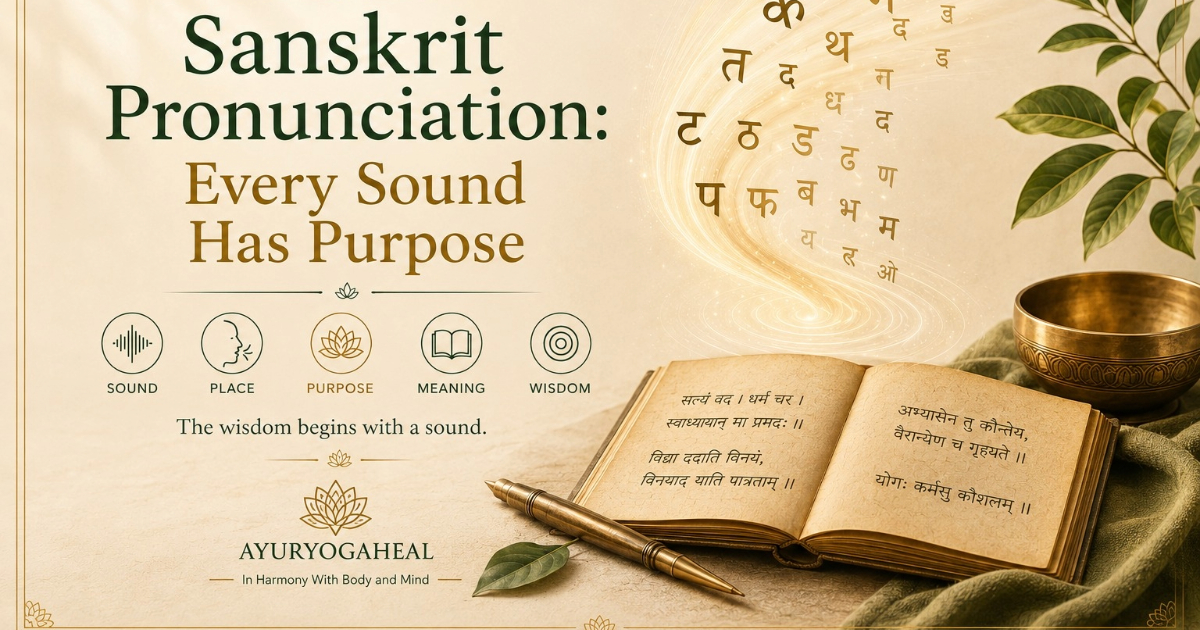
Pure Sanskrit Pronunciation: Every Sound Has Purpose
Sanskrit is a language of wisdom that has shaped literature, philosophy, Yoga, Ayurveda and everyday thought across generations.
But before we explore what a Sanskrit word means, there is something more fundamental to understand:
its sound.
Sanskrit has a highly organised sound system. Its consonants are traditionally arranged according to where and how they are produced in the mouth, with distinctions such as voicing and aspiration forming an integral part of the language.
For a learner, pronunciation is therefore not an afterthought.
The sound is part of the learning.
Why Sanskrit Pronunciation Matters
त — ta
थ — tha
and
ट — ṭa
ठ — ṭha
The Roman spelling alone does not fully capture these differences.
Sanskrit therefore asks the learner to notice where a sound is formed, how it is formed, and how it differs from another sound.
This is where pronunciation becomes more than simply saying a word correctly. It becomes a way of understanding the structure of the language.
The Five Main Places of Articulation
The traditional Sanskrit sound system groups its five main consonant rows according to their primary place of articulation.
| Sanskrit term | Place of articulation | Sound group | Examples |
|---|---|---|---|
| Kaṇṭhya | Throat / back of the mouth | क-वर्ग | क ख ग घ ङ |
| Tālavya | Palate | च-वर्ग | च छ ज झ ञ |
| Mūrdhanya | Roof of the mouth / retroflex position | ट-वर्ग | ट ठ ड ढ ण |
| Dantya | Teeth | त-वर्ग | त थ द ध न |
| Oṣṭhya | Lips | प-वर्ग | प फ ब भ म |
This arrangement reveals something important for the learner:
The Sanskrit alphabet is not simply a list of letters to memorise.
Its sounds follow an underlying phonetic organisation, helping us understand where and how each sound is produced.
Five Sounds, Five Distinctions
The first twenty-five consonants are arranged in five groups of five. Within each group, the sounds follow a consistent pattern.
| Order | Sound type | Example | What to notice |
|---|---|---|---|
| 1 | Unvoiced, unaspirated | क ka | No strong breath release |
| 2 | Unvoiced, aspirated | ख kha | Noticeable breath release |
| 3 | Voiced, unaspirated | ग ga | The sound is voiced |
| 4 | Voiced, aspirated | घ gha | Voice with a noticeable breath release |
| 5 | Nasal | ङ ṅa | The sound resonates through the nose |
This same pattern continues through the other consonant groups:
च छ ज झ ञ
ट ठ ड ढ ण
त थ द ध न
प फ ब भ म
The place of articulation changes from group to group, but the five-position pattern remains consistent.
Once you recognise this pattern, Sanskrit pronunciation becomes less about memorising isolated sounds and more about understanding a system.
What Does “Aspirated” Mean?
One of the most important pronunciation distinctions for Sanskrit learners is aspiration.
Compare:
क — ka
ख — kha
The second sound is produced with an audible release of breath.
The same distinction appears in:
ग — ga / घ — gha
त — ta / थ — tha
द — da / ध — dha
प — pa / फ — pha
A simple way to experience aspiration
Place your palm a short distance in front of your mouth.
Now say:
ka — kha
You should notice a stronger puff of air with kha.
Try the same with:
ta — tha
The difference is not simply a matter of adding an extra sound. The breath release is part of the pronunciation itself.
This simple exercise turns an abstract pronunciation rule into something you can physically feel and recognise.
When Tongue Position Changes the Sound
Another important distinction in Sanskrit comes from where the tongue is positioned.
Compare:
त — ta
ट — ṭa
and:
द — da
ड — ḍa
and:
न — na
ण — ṇa
In the dental sounds त (ta), द (da) and न (na), the tongue makes contact near the upper teeth. In the retroflex sounds ट (ṭa), ड (ḍa) and ण (ṇa), the tongue is raised and curled back.
These are not simply different ways of writing the same sound. They represent distinct Sanskrit consonants.
For a beginner, learning to gradually hear and produce these differences is far more useful than trying to fit them into familiar English pronunciation.
The goal is not perfect pronunciation at once, but becoming aware that a small change in tongue position can create a different Sanskrit sound.
From Sound to Meaning
This is perhaps the most beautiful place to begin learning Sanskrit.
A written letter becomes a sound.
A sound becomes a word.
A word carries meaning.
For example, exploring the Sanskrit word swastha shows how a word can carry meaning beyond its simple English translation.
And words come together to express an idea.
That movement — from sound to meaning — is central to experiencing Sanskrit.
This is why learning pronunciation is not merely about speaking Sanskrit “correctly.”
It is about becoming more attentive to the language itself — to its sounds, its structure, and the meaning it carries.
A Simple Way to Begin
You do not need to know Sanskrit grammar to begin.
Start simply:
Listen → Observe → Repeat → Distinguish → Understand
Begin by listening carefully to the difference between:
क — ख
त — ट
द — ड
न — ण
प — फ
Then gradually move from individual sounds to words, and from words to shlokas and meaningful expressions.
With practice, pronunciation stops feeling like a technical exercise and becomes part of your familiarity with the language.
Can You Crack the Sanskrit Sound Code?
A 3-minute Sanskrit challenge — no prior knowledge needed!
You have discovered that Sanskrit sounds follow an organised pattern. Now, let’s see if you can recognise some of these differences yourself.
Don’t worry about getting every answer right. The aim is to observe, try and discover.
Challenge 1: Can You Spot the Breath?
Look at these two Sanskrit letters:
क — ka
ख — kha
Both sounds are produced towards the back of the mouth, but there is an important difference.
Which letter represents the sound produced with a stronger release of breath?
A. क — ka
B. ख — kha
C. ग — ga
Take a moment to decide before checking the answer below.
Your discovery: ख (kha) is the aspirated counterpart of क (ka). When you try saying them aloud, notice the stronger release of breath with kha.
Challenge 2: Where Is Your Tongue?
Now compare:
त — ta
ट — ṭa
They may look similar in English transliteration, but Sanskrit distinguishes these sounds carefully.
Which sound is produced with the tongue curled back towards the roof of the mouth?
A. त — ta
B. ट — ṭa
Your discovery: ट (ṭa) is the retroflex sound, produced with the tongue curled back. त (ta) is dental, produced with the tongue near the upper teeth.
The small dot beneath the ṭ in the transliteration is an important clue!
Challenge 3: Can You Discover the Pattern?
Look at these pairs:
क — ख (ka — kha)
ग — घ (ga — gha)
What do you notice?
A. Both pairs contain the same letter repeated.
B. Both pairs demonstrate a difference between unaspirated and aspirated sounds.
C. The pairs have no relationship to each other.
Your discovery: The answer is B. In each pair, the second consonant is aspirated. Recognising this pattern helps you understand how Sanskrit sounds are organised instead of memorising each letter in isolation.
What Have You Discovered?
You have just explored three important ideas:
A small difference in breath can distinguish Sanskrit sounds.
Tongue position matters when producing different consonants.
Sanskrit letters follow patterns that help us learn systematically.
This is the beginning of understanding Sanskrit—not merely memorising its letters, but discovering how its sounds work.
Remember, English transliteration is a helpful starting point, but it cannot represent every feature of Sanskrit pronunciation perfectly. Listening and guided practice can deepen your understanding further.
Where Would You Like to Go Next?
Have a question or want to share your experience?
We would love to hear what you discovered, what you found challenging, and what you would like to learn next.
Ready to explore Sanskrit further?
Move beyond individual sounds and discover Sanskrit words, meanings and the knowledge they carry. Explore a learning journey designed to help you understand Sanskrit rather than simply memorise it.
Begin with the Sound
Sanskrit invites us to explore language, thought, culture and meaning—not to master everything at once, but to discover what each sound and word can reveal.
At Ayuryogaheal, we see Sanskrit as a doorway into a wider world of knowledge.
Listen to the sound. Notice the difference. Discover the meaning.
That is where the journey begins.