
Daily Sanskrit Slokas for a Balanced Life: From Morning Gratitude to Night Forgiveness
What if a few simple daily Sanskrit slokas could gently shape the way you experience your entire day?
For centuries, these timeless verses have accompanied everyday moments—from the gratitude of waking, to learning with humility, working with purpose, nurturing relationships with compassion, and ending the day with forgiveness and peaceful rest. More than prayers or chants, they are gentle reminders to pause, reflect and live with greater awareness.
You don’t need to be fluent in Sanskrit to benefit from its wisdom. Each sloka offers a practical insight that can be applied to modern life, helping transform ordinary routines into meaningful daily practices.
At Ayuryogaheal, we believe every Sanskrit verse carries a deeper story. By exploring its language, understanding its connection with Ayurveda and Yoga, and reflecting on its relevance in everyday life, these ancient teachings become practical companions for living in harmony with body, mind and spirit.
New to Sanskrit? Explore our complete Introduction to Sanskrit and discover why this ancient language still matters today.
When Every Moment Has a Verse
Life is made up of ordinary moments—waking in the morning, preparing for the day, learning, working, connecting with others and finally resting at night. Indian knowledge traditions recognised that each of these everyday experiences offers an opportunity to cultivate awareness, gratitude and inner balance.
The daily Sanskrit slokas in this guide follow that natural rhythm of daily life. Beginning with the first light of dawn and ending with peaceful sleep, each verse offers a simple reflection that can gently influence the way we think, act and relate to the world around us.
Rather than viewing these slokas as isolated prayers, consider them as companions for daily living. Together, they weave the timeless wisdom of Sanskrit, the holistic principles of Ayurveda and the mindful practices of Yoga into one harmonious journey—one meaningful moment at a time.
Pause for a moment…
As you read each sloka, don’t feel you need to memorise it. Instead, ask yourself:
“How could this one verse influence the way I live today?”
These daily practices reflect the deeper connection between Sanskrit, Ayurveda and Yoga, where language, health and mindful living come together.
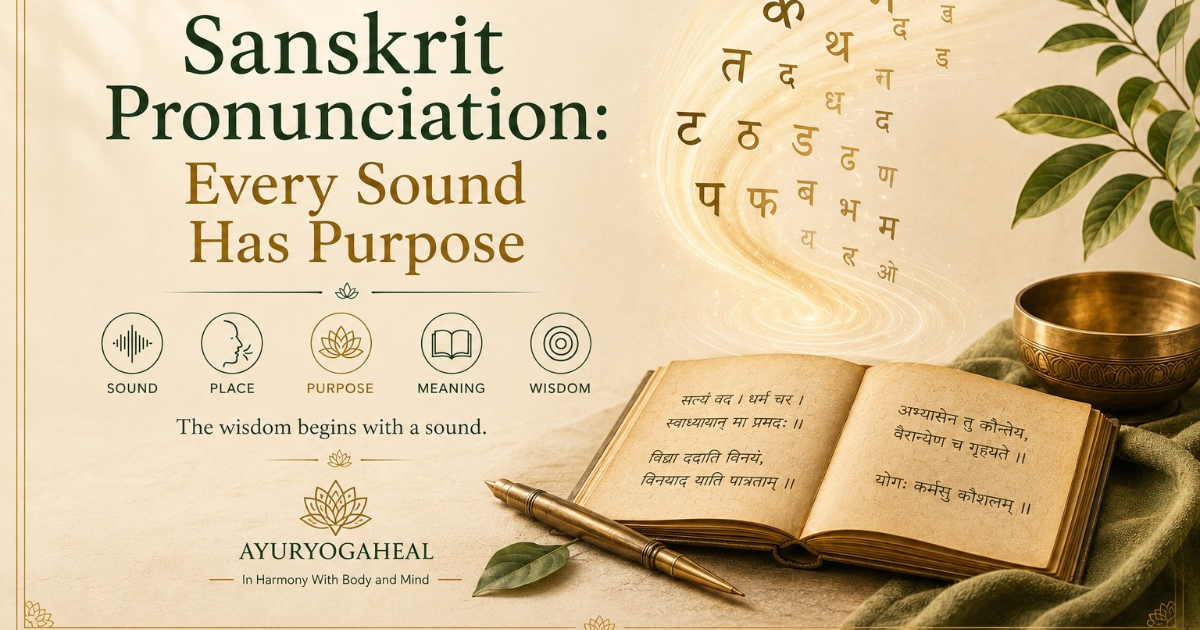
Before we explore the individual slokas, it is worth noticing the language itself. Sanskrit pronunciation follows a carefully organised sound system, where small differences in sound create distinct consonants.
1. Morning Awakening – Gratitude for Life
कराग्रे वसते लक्ष्मीः करमध्ये सरस्वती।
करमूले तु गोविन्दः प्रभाते करदर्शनम्॥
Meaning:
I begin my day by recognising abundance, wisdom, and divine energy in my own hands.
Ayuryogaheal Insight
The quality of our day is often shaped by the very first thought we choose upon waking. Instead of rushing into worries or distractions, this beautiful morning sloka invites us to begin with gratitude and quiet confidence. It reminds us that the ability to create, learn and serve already exists within us.
In Ayurveda and Yoga, the mind is most receptive in the early morning. Beginning the day with a positive intention helps cultivate clarity, steadiness and a sense of purpose that can gently influence everything that follows.
Today’s Reflection
Before reaching for your phone tomorrow morning, pause for a few moments. Look at your hands, recite this sloka if you know it, and ask yourself:“How can I use my abilities to bring something positive into today?”
2. Bathing – Inner Cleansing
गङ्गे च यमुने चैव गोदावरि सरस्वति।
नर्मदे सिन्धु कावेरि जलेऽस्मिन् सन्निधिं कुरु॥
Meaning:
May all sacred energies purify me through this water.
Ayuryogaheal Insight
Bathing is more than a physical routine—it can become a quiet moment of renewal. This traditional prayer reminds us that while water cleanses the body, awareness refreshes the mind. By pausing with gratitude before an everyday act, even the simplest routines can become meaningful rituals.
In Ayurveda, the morning cleansing routine is an important part of Dinacharya (daily self-care). It prepares both the body and the mind for the day ahead, encouraging freshness, clarity and a sense of wellbeing from the very beginning of the day.
3. Health – Ayurveda Definition of Well being
समदोषः समाग्निश्च समधातु मलक्रियः।
प्रसन्नात्मेन्द्रियमनाः स्वस्थ इत्यभिधीयते॥
Meaning:
True health is a state in which the doshas, digestive fire (Agni), body tissues and natural elimination remain in balance, while the mind, senses and spirit are peaceful and content.
— Sushruta Samhita
Ayuryogaheal Insight
This timeless verse is one of the most profound definitions of health found in Ayurveda. Rather than describing health as simply the absence of disease, it presents Swastha as a dynamic state of harmony—where the body functions efficiently, the mind remains calm, the senses are balanced and the inner self is at peace.
True wellbeing is not something we achieve once and hold forever. It is nurtured each day through the choices we make—how we eat, sleep, move, think and care for ourselves. This holistic perspective continues to guide Ayurvedic practice thousands of years after it was first described.
Explore the complete Ayurvedic definition of health to understand the classical verse and how its principles relate to everyday life.
This verse gives us the Ayurvedic understanding of health through the idea of Swastha. If you would like to explore the Sanskrit meaning behind this concept, begin here:
- What does Swastha really mean?
- Understanding the Three Doshas
- Why Agni is the Foundation of Health
- How Ojas Supports Vitality and Immunity
Today’s Reflection
Instead of asking, “Am I sick?” try asking, “What small step can I take today to bring my body and mind into better balance?”
4. Work Ethic – Karma Yoga
कर्मण्येवाधिकारस्ते मा फलेषु कदाचन।
मा कर्मफलहेतुर्भूर्मा ते सङ्गोऽस्त्वकर्मणि॥
Meaning:
Focus on your actions, not on the results. Do your duty with sincerity, without becoming attached to the outcome.
— Bhagavad Gita
Ayuryogaheal Insight
In today’s fast-paced world, we often measure our worth by achievements, recognition or immediate results. This timeless teaching of Karma Yoga gently reminds us that while we can control our effort, we cannot always control the outcome.
Peace often comes not from doing less, but from letting go of the need to control every result. When we give our best with sincerity and presence, our work becomes more meaningful, our minds become calmer and our actions become guided by purpose rather than pressure.
5. Learning – Humility & Growth
विद्या ददाति विनयं विनयाद् याति पात्रताम्।
पात्रत्वात् धनमाप्नोति धनात् धर्मं ततः सुखम्॥
Meaning:
True knowledge nurtures humility. Humility leads to worthiness, worthiness opens the door to prosperity, prosperity supports righteous living, and from righteous living comes lasting happiness.
Ayuryogaheal Insight
Learning is not measured simply by how much we know, but by how deeply it transforms us. This timeless verse reminds us that true knowledge begins with humility—the willingness to remain curious, respectful and open to continuous learning.
Whether we study Sanskrit, Ayurveda, Yoga or any other subject, knowledge reaches its highest purpose when it shapes our character as much as our understanding. As wisdom grows, so does our ability to make thoughtful choices, contribute meaningfully and find fulfilment beyond external success.
Today’s Reflection
Ask yourself:
“What is one lesson I learned recently that has changed not just what I know, but how I think or live?”
Take a quiet moment to reflect. True learning is not measured by how much we remember, but by how deeply it shapes the way we think, act and grow.
6. Mental Strength – Fearlessness
उद्धरेदात्मनाऽत्मानं नात्मानमवसादयेत्।
आत्मैव ह्यात्मनो बन्धुरात्मैव रिपुरात्मनः॥
Meaning:
You are your own best friend or worst enemy.
Ayuryogaheal Insight
This profound teaching reminds us that our greatest support and our greatest challenge often come from within. The mind has the power to uplift us through clarity, discipline and self-awareness, or to hold us back through fear, doubt and negative habits. By gently cultivating positive thoughts, mindful actions and self-compassion each day, we gradually become our own strongest ally on the journey towards wellbeing.
7. Relationships – Universal Family
वसुधैव कुटुम्बकम्
Meaning:
The world is one family.
Ayuryogaheal Insight
This timeless teaching invites us to look beyond differences and recognise the shared humanity that connects us all. In a world that often feels divided, this simple yet profound idea reminds us that lasting wellbeing grows through connection, compassion and living in harmony with one another.
8. Desire – Contentment
सन्तोषः परमं सुखम्
Meaning:
Contentment is the highest happiness.
Ayuryogaheal Insight
Contentment does not ask us to stop growing; it teaches us to appreciate the present while continuing to grow with purpose rather than endless comparison. This timeless teaching reminds us that lasting happiness comes not from constantly chasing more, but from recognising the value of what we already have while moving forward with gratitude, balance and intention.
9. Ethics – Yoga Yamas
अहिंसा सत्य अस्तेय ब्रह्मचर्य अपरिग्रहाः
Meaning:
Non-violence, truth, moderation, non-possessiveness.
Ayuryogaheal Insight
The Yamas are timeless principles that guide us towards living with integrity, compassion and self-awareness. Rather than a set of rigid rules, they invite us to make thoughtful choices that bring greater harmony to our relationships, our actions and our inner life. When practised with understanding rather than fear, these values become a natural foundation for lasting wellbeing and personal growth.
The Yamas are the first step of the eightfold path of Yoga, showing us that Yoga begins long before we step onto a mat. Every act of kindness, honesty, moderation and compassion becomes part of our practice. Learn how Yoga extends beyond physical postures in our guide to Yoga Beyond the Mat.
10. Night – Sacred Sleep
या देवी सर्वभूतेषु निद्रारूपेण संस्थिता।
नमस्तस्यै नमस्तस्यै नमस्तस्यै नमो नमः॥
Meaning:
Sleep itself is divine.
Ayuryogaheal Insight
Rest is not the absence of activity; it is the process through which life quietly restores itself. Honouring sleep is an essential part of caring for both body and mind.
Today’s Reflection
Before you sleep tonight, ask yourself:
“What can I let go of today so that I wake up tomorrow with a peaceful mind and a grateful heart?”
Take a quiet moment to release the day’s worries, appreciate even the smallest blessings, and welcome sleep as a time of renewal. Just as each morning offers a new beginning, every restful night prepares us to greet the next day with greater balance, clarity and purpose.
In Ayurveda, Nidra (sleep) is one of the three pillars that sustain life. Quality sleep nourishes the body, calms the mind and helps maintain the balance essential for long-term health and wellbeing.
Continue reading: Nidra – Why Sleep Is One of Ayurveda’s Three Pillars of Health
These ten timeless slokas are more than beautiful verses—they are gentle companions for everyday living. As your understanding of Sanskrit deepens, so too does your appreciation of the wisdom they carry.
Sharing Sanskrit with Children?
Many children enjoy chanting Sanskrit long before they fully understand its meaning. Introducing simple slokas at an early age helps them develop confidence, pronunciation and an appreciation for India’s timeless wisdom in a natural and enjoyable way.
Our collection of 10 Easy Sanskrit Slokas for Children includes pronunciation, meanings and everyday relevance, making it easy for families to learn and practise together.
Where Do These Timeless Slokas Come From?
The wisdom shared in these daily slokas comes from some of India’s most respected scriptures and classical texts. Together, they reflect the enduring traditions of Sanskrit, Ayurveda, Yoga and Indian philosophy that continue to inspire balanced living today.
| Sloka | Source |
|---|---|
| Karagre Vasate Lakshmi | Traditional Morning Prayer |
| Samadoshah Samagnischa | Sushruta Samhita |
| Karmanye Vadhikaraste | Bhagavad Gita |
| Vidya Dadati Vinayam | Hitopadesha |
| Vasudhaiva Kutumbakam | Maha Upanishad |
| Santoshah Paramam Sukham | Ancient Subhashita |
| Yamas | Yoga Sutras |
| Nidra Sloka | Devi Mahatmyam |
Why These Slokas Work (Modern Science)
The wisdom of these Sanskrit slokas is increasingly supported by modern research. Practices such as gratitude, mindful reflection and positive affirmations have been shown to reduce stress, improve emotional wellbeing and strengthen resilience. Rather than isolated rituals, these daily slokas naturally encourage many of these beneficial habits through simple moments of awareness woven into everyday life.
Bring These Slokas Into Your Daily Life
| Age Group | Practice |
|---|---|
| Children | 1 sloka morning + 1 night |
| Youth | One sloka per day with reflection |
| Adults | Chant during meditation |
| Families | Sloka circle before bed |
Ready to Understand Sanskrit Beyond the Translation?
You’ve discovered how a few Sanskrit verses can bring greater gratitude, balance and awareness into everyday life. Imagine how much richer they become when you begin to understand the language behind them.
Whether you’re learning Sanskrit to deepen your understanding of Ayurveda and Yoga, explore the wisdom within these timeless verses, or share them with your children, our beginner-friendly approach helps you learn with confidence—one step at a time.
With Ayuryogaheal you’ll learn to:
✓ Understand the meaning behind Sanskrit words
✓ Recognise simple grammar naturally
✓ Connect Sanskrit with Ayurveda and Yoga
✓ Build confidence at your own pace
Ayuryogaheal Philosophy
Ayurveda nurtures the body.
Yoga steadies the mind.
Sanskrit reveals the timeless wisdom that connects them.
Together, they offer a practical path to living in harmony with body, mind and spirit.
If even one sloka inspires a small positive change in your day, share this guide with someone who may benefit from its timeless wisdom. Together, we can keep the living tradition of Sanskrit alive—one meaningful verse at a time.
Have Something You’d Like to Explore?
Perhaps a Sanskrit verse has sparked your curiosity, you want to understand the wisdom behind Ayurveda and Yoga, or you’re simply wondering where to begin.
Tell us what’s on your mind, in your own words. Your thoughts, questions and learning goals will help us understand what matters to you and explore how we can support your journey.