What Is Ayurveda? Why Ayurveda Matters Today
Ayurveda is a traditional system of health knowledge from India that offers a way of understanding health, individuality, daily habits, digestion, sleep, environment, and well-being as interconnected parts of life.
The word Ayurveda is traditionally understood as the knowledge of life. Rather than looking at health only when something goes wrong, Ayurveda places importance on understanding the factors that influence our well-being and learning how to care for health through awareness, appropriate habits, and balance.
But what does Ayurveda actually mean for someone living today?
Modern life has changed dramatically. Our routines are often shaped by screens, irregular meals, sedentary work, changing sleep patterns, stress, and constant stimulation. Ayurveda offers a framework for observing how these influences interact with our individual nature and daily life.
This is why Ayurveda continues to matter today—not simply as a collection of traditional remedies, but as a way of learning to understand health, individuality, digestion, daily rhythm, seasonal change, and mindful living.
This page brings together the foundational ideas of Ayurveda as a connected learning journey. From Swastha and Deha Prakriti to Doshas, Agni, Ama and Ojas, and from daily and seasonal rhythms to the broader principles of Yoga and Sanskrit, each concept helps build a deeper understanding of how Ayurveda approaches life and well-being.
Understanding the Foundations of Ayurveda
Ayurveda becomes easier to understand when its foundational concepts are viewed as parts of a connected system rather than as isolated terms.
Some of the key ideas you will encounter are:
Swastha — understanding health
Deha Prakriti — understanding individual constitution
Doshas — understanding functional patterns
Agni — understanding digestion and transformation
Ama — understanding impaired transformation
Ojas — understanding nourishment and vitality
Together, these concepts provide different ways of understanding how Ayurveda approaches health, individuality and everyday well-being.
You can explore each one more deeply as you move through the Ayurveda journey.
Ayurveda as a Way of Living
Ayurveda is not only a system of concepts to learn. Its principles can also be explored through everyday aspects of life such as food, sleep, daily routines, seasonal awareness, movement and mindful living.
The purpose is not to create a perfect routine or change everything at once. It is to develop greater awareness of how our choices, habits, environment and individual nature influence well-being over time.
This is where Ayurveda moves from knowledge into everyday observation: How do I sleep? How do I digest my food? What happens when my routine changes? How does the season affect me? What habits support me, and which ones leave me feeling out of balance?
What Does It Mean to Be Healthy? — Swastha
One of the first questions Ayurveda asks is not simply “What is illness?” but “What does it mean to be healthy?”
The Ayurvedic concept of Swastha offers a broader way of looking at health. The word is associated with being established or situated in oneself, and Ayurveda describes health as a state involving the harmonious functioning of the body, mind and other aspects of well-being.
This gives us a starting point for understanding Ayurveda: health is more than simply the absence of disease. It involves the way we function, live and remain connected with our own state of well-being.
Want to explore the Ayurvedic understanding of health in greater depth?
[Read: Understanding Swastha in Ayurveda]
Understanding Individuality: Deha Prakriti
Ayurveda begins with an important recognition: each person is different.
Our constitution, circumstances, habits and environment can influence how we experience health and balance. This understanding of individual constitution is called Deha Prakriti.
Instead of asking only:
“What works for everyone?”
Ayurveda encourages us to consider:
“What may support balance and well-being for this individual?”
Understanding Deha Prakriti gives us a foundation for exploring the Doshas and the different ways Ayurvedic principles may be understood in relation to individual constitution.
Understanding Doshas: Patterns of Function
Ayurveda describes three fundamental functional principles known as the Doshas:
- Vata — associated with movement and change
- Pitta — associated with transformation
- Kapha — associated with structure and stability
Everyone has all three Doshas, but their relative expression differs from person to person.
The Doshas provide a framework for understanding individual tendencies and changing states of balance. This helps explain why Ayurveda does not approach health as though one routine, diet or lifestyle will necessarily suit everyone in the same way.
From here, the journey moves from individual patterns to one of Ayurveda’s central functions: digestion and transformation through Agni.
Agni: Digestion and Transformation
Ayurveda places great importance on Agni, the principle associated with digestion and transformation.
Agni helps us understand how Ayurveda views digestion, nourishment and the processing of what we take in.
When we understand Agni, we begin to see why digestion occupies such an important place in Ayurvedic thinking—and why everyday habits can influence more than simply what happens after a meal.
This leads naturally to Ama, a concept Ayurveda uses to describe what may result when digestion and processing are impaired.
Ama: When Digestion and Processing Are Impaired
Ayurveda describes Ama as a concept associated with incomplete digestion and impaired processing.
Its place in the Ayurvedic framework becomes clearer when viewed alongside Agni: Agni represents digestion and transformation, while Ama is associated with the consequences of impaired processing.
Understanding this relationship helps explain why Ayurveda places such emphasis on healthy digestion, appropriate habits and maintaining balanced Agni.
The journey then moves beyond digestion toward another important question:
How does Ayurveda understand nourishment, strength and vitality?
This brings us to Ojas.
Ojas: Nourishment, Strength and Vitality
Ayurveda describes Ojas as a subtle essence associated with nourishment, strength, vitality and resilience.
Within the broader Ayurvedic framework, Ojas helps us look beyond digestion itself toward the idea of sustained nourishment and vitality.
Seen together, the concepts of Agni, Ama and Ojas create an important part of the Ayurvedic understanding of well-being:
Agni → digestion and transformation
Ama → impaired processing
Ojas → nourishment and vitality
This connection helps bring the earlier concepts together. Ayurveda is not looking at digestion, constitution, health and vitality as completely separate subjects. It considers them as interconnected aspects of understanding the individual and supporting well-being.
Ayurveda in Everyday Life
Understanding Ayurvedic concepts is only the beginning. Their practical value becomes clearer when we consider how Ayurveda approaches daily rhythms, seasonal changes, nourishment, sleep and the way we use our energy.
Rather than prescribing one perfect lifestyle for everyone, Ayurveda encourages observation and adaptation: noticing what changes with our routines, environment and circumstances, and making thoughtful adjustments over time.
Three important frameworks help bring this perspective into everyday life: Dinacharya, Ritucharya, and Trayopastambha.
Dinacharya: Creating Rhythm Through Daily Routine
Dinacharya refers to the Ayurvedic approach to daily routine.
It brings attention to the rhythm of everyday activities such as waking, cleansing, eating, working, resting and sleeping.
The emphasis is not necessarily on following a rigid schedule. Instead, Dinacharya encourages greater consistency and awareness in daily habits that can support digestion, energy and overall well-being.
It is one of the clearest examples of how Ayurvedic principles can move from theory into everyday practice.
Ritucharya: Adapting to Seasonal Change
Ayurveda also recognizes that seasons and environmental conditions change, and that our routines and needs may change with them.
Ritucharya refers to the Ayurvedic approach to adapting habits, food, activity and self-care in response to seasonal changes.
The underlying principle is simple: rather than assuming that the same routine is appropriate throughout the year, Ayurveda encourages us to observe our environment and respond with awareness.
This introduces an important idea in Ayurvedic thinking: well-being is dynamic and requires ongoing observation and adaptation.
Trayopastambha: Three Supports of Life
Another practical framework is Trayopastambha, which describes three important supports of health:
- Ahara — nourishment through food
- Nidra — sleep and rest
- Brahmacharya — balanced and mindful use of energy and conduct
Together, these highlight three fundamental areas of everyday life that Ayurveda considers important to well-being.
Trayopastambha therefore connects the broader Ayurvedic framework with questions that are highly relevant to everyday life: How do we nourish ourselves? How do we rest? How do we use our energy and conduct our lives?
Seen alongside Dinacharya and Ritucharya, these principles show how Ayurveda moves from understanding health to observing, adapting and supporting it through daily living.
Prevention: Caring for Health Before Imbalance
One of Ayurveda’s defining ideas is that caring for health is not limited to responding when something goes wrong.
Its classical purpose includes protecting the health of those who are healthy as well as addressing disorders when they arise.
In everyday life, this perspective begins with paying attention: noticing changes in digestion, sleep, energy, routine and overall well-being, and learning from those observations.
A simple way to express this approach is:
Notice. Understand. Adapt.
Rather than waiting until a problem becomes established, Ayurveda encourages an ongoing relationship with health.
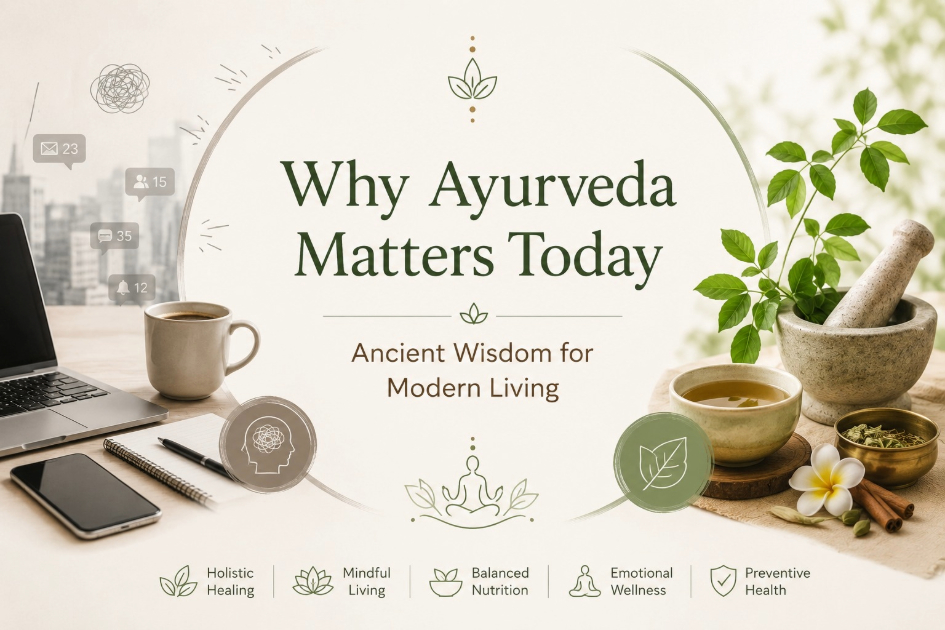
Why Ayurveda Matters Today
Modern life brings circumstances that can make this awareness especially relevant: irregular routines, sedentary work, changing sleep patterns, constant stimulation and ongoing stress.
Ayurveda offers a framework for observing how our individual nature, habits, routines and environment interact.
It does not require us to step away from modern life.
Instead, its principles invite us to ask better everyday questions:
How are my routines affecting me?
What happens when my sleep or eating patterns change?
How does my body respond to seasonal changes?
What habits appear to support my well-being?
These questions bring Ayurveda back to where our journey began: understanding health through greater awareness of ourselves and the way we live.
A Timeless Ayurvedic Teaching
The purpose of Ayurveda is expressed clearly in the Charaka Samhita:
प्रयोजनं चास्य स्वस्थस्य स्वास्थ्यरक्षणम् ।
आतुरस्य विकारप्रशमनं च ॥
Prayojanaṃ cāsya svasthasya svāsthyarakṣaṇam, āturasya vikāra-praśamanaṃ ca.
“The purpose of Ayurveda is to protect the health of the healthy and to alleviate disorders in the sick.”
— Charaka Samhita, Sutrasthana 30.26
This verse brings together the two broad purposes of Ayurveda: preserving health and responding to disorder.
It also provides a useful lens through which to understand everything explored on this page—from Swastha and individual constitution to digestion, daily routines and seasonal awareness.
Health is worth caring for, not only restoring.
What We Share At Ayuryogaheal
At Ayuryogaheal, we bring together Ayurveda, Yoga and Sanskrit to make these traditions easier to explore and understand in the context of modern life.
Ayurveda
Understanding health, individuality, digestion, daily living and seasonal rhythms.
Yoga
Exploring movement, breath, awareness and practices connected with a balanced way of living.
Sanskrit
Discovering the language and meaning behind many of the concepts found in Ayurveda and Yoga.
Practical Resources
Guides, checklists and learning resources designed to help turn understanding into thoughtful everyday practice.
Our aim is not simply to provide information, but to help you explore these traditions, understand their principles and discover where your own learning can go next.
Explore Ayurveda More Deeply
You do not need to learn everything at once.
Start with one concept that interests you and explore it further.
Swastha — understanding health and well-being
Deha Prakriti — understanding individual constitution
Doshas — exploring functional patterns
Agni — understanding digestion and transformation
Ama — understanding impaired digestion and processing
Ojas — exploring nourishment, vitality and resilience
Dinacharya — understanding daily rhythms
Ritucharya — adapting to seasonal change
Each topic offers a deeper look at one aspect of Ayurveda while helping you understand how the principles connect as a whole.
Start with what you want to understand, and take the next step from there.
Need Personal Guidance?
Have questions about your health and well-being? Explore personalised Ayurvedic guidance with Ayuryogaheal.
Speak to an Ayuryogaheal Doctor →
Closing thought
Health is not a destination. It is an ongoing relationship with ourselves and the world around us.
Ayurveda invites us to make that relationship more conscious—one observation, one choice and one day at a time.
Frequently Asked Questions (FAQ)
What is Ayurveda?
Ayurveda is a traditional system of health knowledge from India that takes an interconnected view of health, individuality, daily habits, digestion, lifestyle and environment.
What is the main purpose of Ayurveda?
Ayurveda traditionally places importance on protecting health and addressing disorders when they arise. It also encourages awareness of the factors that influence individual well-being.
Why does Ayurveda consider each person different?
Ayurveda recognizes that individual constitution, habits, environment and circumstances can differ from person to person. This is one reason it does not assume that the same approach will suit everyone.
What are the Doshas in Ayurveda?
Vata, Pitta and Kapha are the three Doshas described in Ayurveda. They provide a framework for understanding different functional patterns and individual tendencies.
What are Agni, Ama and Ojas?
Agni is associated with digestion and transformation, Ama with impaired digestion and processing, and Ojas with nourishment, strength, vitality and resilience. These concepts are interconnected within the broader Ayurvedic framework.
Can Ayurveda be part of modern life?
Yes. Ayurvedic principles can be explored through daily routines, food and digestion, seasonal awareness, sleep, self-observation and mindful living, while appropriate modern healthcare continues to be used when needed.
Do I need to follow everything in Ayurveda at once?
No. Ayurveda can be explored gradually. Starting with one concept, one observation or one everyday habit can be a practical way to begin learning.