Ojas in Ayurveda: Meaning, Importance, Signs and Ways to Support Vitality
Two people may follow similar routines, eat nourishing meals, and face similar challenges, yet experience health differently. One may remain calm, energetic, and resilient, while another may feel depleted or less able to cope with everyday demands.
Ayurveda looks beyond physical strength alone to understand this difference. At the heart of this perspective is Ojas—an Ayurvedic concept associated with vitality, strength, resilience, nourishment, and the ability to sustain well-being.
Ojas is traditionally understood in relation to nourishment, healthy tissues, restorative rest, and balanced living. It is not something that is built overnight, but is connected with how the body and mind are supported over time.
Understanding Ojas therefore offers a broader Ayurvedic perspective on health—not simply as the absence of illness, but as the cultivation and preservation of vitality, stability, and resilience.
In this guide, you’ll discover:
- What Ojas means in Ayurveda
- Why Ojas is associated with vitality, strength, and resilience
- How healthy and depleted Ojas may be described in Ayurveda
- The relationship between Ojas, Agni, Ama, Dhatus, and the Doshas
- Foods and lifestyle practices traditionally associated with supporting Ojas
- How everyday habits can help preserve vitality and well-being
Quick Definition
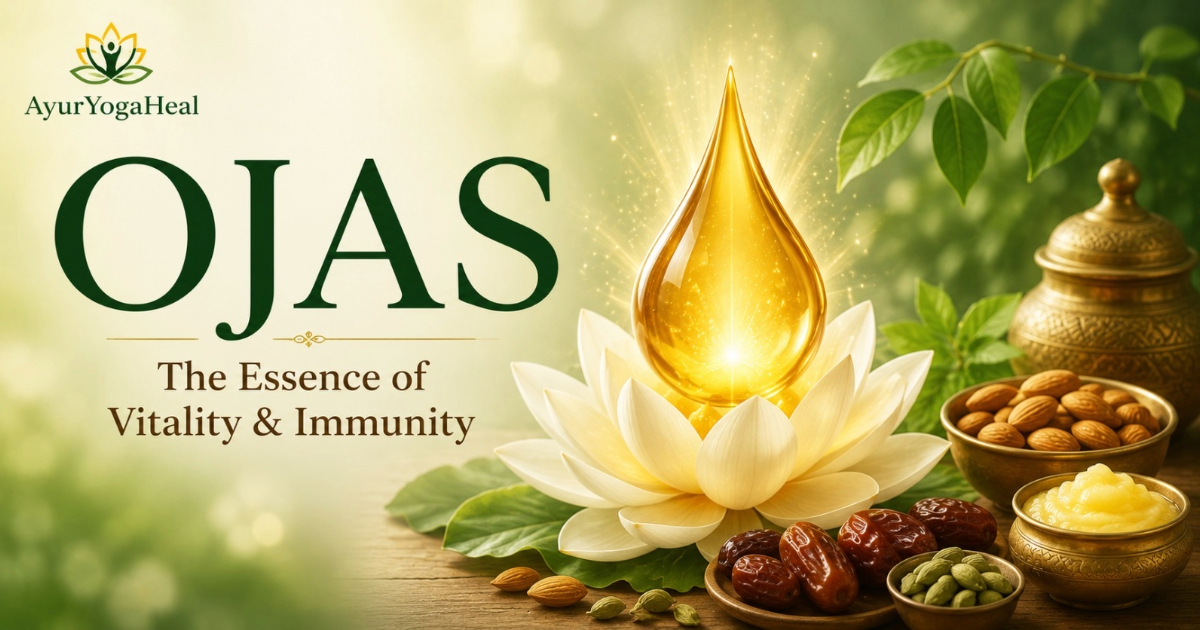
Ojas is described in Ayurveda as a subtle essence associated with nourishment, vitality, strength, resilience, and the sustaining of life.
What Is Ojas in Ayurveda?
Ojas is a distinctive concept in Ayurveda, traditionally described in relation to the seven Dhatus, or body tissues. It represents a refined aspect of nourishment and is associated with strength, vitality, resilience, and the ability to sustain life.
Rather than thinking of Ojas simply as physical energy, it is more useful to understand it within the larger Ayurvedic framework of nourishment and balance.
Agni transforms and processes nourishment.
Dhatus represent the body’s tissues and their nourishment.
Ojas is associated with the deeper vitality that emerges when nourishment and physiological processes are properly supported.
This is why Ojas cannot be reduced to a single modern equivalent such as energy or immunity. Ayurveda connects it with a broader range of qualities, including:
- Strength and endurance
- Vitality and resilience
- Stability and well-being
- Mental and emotional steadiness
- The capacity to withstand and recover from challenges
Ojas is therefore best understood as part of an interconnected Ayurvedic view of health, rather than as an isolated substance or a simple measure of physical energy.
As we explore Ojas further, its relationship with Agni, Ama, Dhatus, and the Doshas becomes especially important. These connections help explain why Ayurveda places emphasis not only on illness, but also on preserving nourishment, balance, and vitality.
The Sanskrit Reference for Ojas in Ayurveda
Classical Ayurvedic texts describe Ojas as a vital essence associated with the Dhatus, the body’s tissues, and with the sustaining of life. One important classical reference appears in the Ashtanga Hridaya, Sutrasthana 11.37.
Sanskrit Verse
ओजस्तु तेजो धातूनां शुक्रान्तानां परं स्मृतम् ।
हृदयस्थमपि व्यापि देहस्थितिनिबन्धनम् ॥
— Ashtanga Hridaya, Sutrasthana 11.37
Transliteration
Ojas tu tejo dhātūnāṁ śukrāntānāṁ paraṁ smṛtam |
Hṛdayastham api vyāpi deha-sthiti-nibandhanam ||
Meaning
“Ojas is regarded as the supreme essence of the Dhatus, from Rasa through Shukra. Though located in the heart, it pervades the body and supports the maintenance of life.”
This classical description provides an important foundation for understanding Ojas in Ayurveda. It presents Ojas as more than physical energy or a modern equivalent of immunity. Rather, Ojas is described within Ayurveda as a distinct concept associated with the essence of the Dhatus, vitality, and the sustaining of life.
This reference also helps explain why Ojas is understood in connection with nourishment, tissue support, strength, and overall well-being rather than as an isolated substance.
Why Is Ojas Important in Ayurveda?
Ayurveda places importance on Ojas because it is associated with the body’s ability to maintain strength, stability, vitality, and resilience over time.
Rather than defining health only as the absence of illness, Ayurveda also considers the qualities that support sustained well-being. Ojas is understood within this broader Ayurvedic view of nourishment, balance, and the ability to remain steady through physical and emotional challenges.
When Ojas is well supported, Ayurveda traditionally associates it with qualities such as:
- Strength and endurance
- Steady vitality
- Physical and emotional resilience
- Mental steadiness and clarity
- A sense of stability and well-being
These qualities help explain why Ayurveda emphasizes protecting and preserving Ojas through appropriate nourishment, restorative sleep, balanced routines, and other supportive daily practices.
Signs and Qualities Associated with Healthy Ojas
Classical Ayurvedic descriptions associate well-supported Ojas with a combination of physical, mental, and emotional qualities. These descriptions are best understood as part of the Ayurvedic concept of well-being, rather than as a medical diagnostic checklist.
Physical Qualities
- Natural strength and stamina
- Good endurance
- Healthy appearance
- Well-supported digestion
- A sense of physical vitality
Mental and Emotional Qualities
- Calmness and stability
- Mental clarity
- Emotional resilience
- Contentment
- The ability to remain steady during challenges
Everyday Well-Being
- Restful sleep
- Consistent energy and vitality
- A sense of balance
- The ability to recover and restore after ordinary physical or emotional demands
Together, these qualities illustrate how Ojas in Ayurveda is associated with a deeper state of nourishment, stability, and well-being rather than with a single measurable aspect of health.
Ayurvedic Signs Traditionally Associated With Low Ojas
Ayurvedic literature describes depleted Ojas in terms of reduced strength, vitality, stability, and resilience. These descriptions are part of the traditional Ayurvedic framework and should not be understood as a medical diagnosis.
Some experiences traditionally discussed in relation to depleted Ojas may include:
- Persistent tiredness or reduced vitality
- Feeling less resilient during periods of physical or emotional stress
- Difficulty recovering after physical or mental demands
- Disturbed or unrefreshing sleep
- A sense of mental or emotional depletion
- Reduced enthusiasm or a diminished sense of well-being
These experiences are not specific to Ojas and can have many different causes. They should therefore not be used to self-diagnose Ojas depletion.
From an Ayurvedic perspective, they may instead encourage reflection on whether nourishment, digestion, restorative sleep, daily routine, and overall balance are being adequately supported.
To understand why these factors matter, it helps to explore how Ayurveda describes the formation and nourishment of Ojas.
How Ojas Is Formed
Ayurveda understands Ojas within a broader process of digestion, nourishment, and tissue support.
Food is first processed through Agni, the Ayurvedic principle of digestion and transformation. The resulting nourishment is understood to support the body’s seven Dhatus, or foundational tissues:
- Rasa — nourishing fluid
- Rakta — blood tissue
- Mamsa — muscle tissue
- Meda — adipose tissue
- Asthi — bone tissue
- Majja — marrow
- Shukra — reproductive tissue
Classical Ayurvedic descriptions associate Ojas with the essence or finest aspect of the Dhatus. It is therefore best understood within this interconnected process of nourishment and tissue support, rather than as a separate substance produced by a single step.
A useful way to understand the relationship is:
Agni → nourishment → Dhatu support → Ojas
This relationship is also why Agni and Ama are important when exploring Ojas. Healthy digestion and transformation are part of the Ayurvedic framework through which nourishment is understood to support the tissues and, ultimately, vitality.
The Relationship Between Agni, Ama and Ojas
Ojas is understood within Ayurveda as part of a larger process of digestion, transformation, nourishment, and tissue support. This makes its relationship with Agni and Ama especially important.
Agni — The Principle of Transformation
Agni refers to the Ayurvedic principle of digestion and transformation.
When Agni functions appropriately, food and nourishment can be properly processed and made available to support the body’s tissues. This provides an important foundation for understanding how Ayurveda connects healthy nourishment with the formation and preservation of Ojas.
Understand Agni: Digestive Fire in Ayurveda
Ama — When Transformation Is Impaired
Ama is an Ayurvedic concept associated with incompletely processed material in the context of impaired digestion and metabolism.
From this perspective, when digestion and transformation are disturbed, tissue nourishment may also be affected. Ama therefore provides an important contrast when understanding Ojas: Ayurveda emphasizes appropriate digestion and nourishment as part of the conditions that support vitality and well-being.
Explore Ama and Its Role in Health
Together, these concepts can be understood through a simple Ayurvedic sequence:
Agni supports transformation → nourishment supports the Dhatus → Ojas is associated with deeper vitality
When transformation is impaired, Ama becomes relevant to the picture.
Ojas and the Three Doshas: Vata, Pitta and Kapha
Ayurveda also considers Ojas in relation to the three Doshas — Vata, Pitta, and Kapha.
Rather than viewing each Dosha as directly producing or destroying Ojas, it is more useful to understand that imbalances in the Doshas can influence the conditions that support nourishment, stability, digestion, and vitality.
Vata and Ojas
Vata is traditionally associated with qualities such as movement, dryness, and variability. When these qualities become excessive, Ayurveda emphasizes appropriate nourishment, adequate rest, regularity, and grounding practices to help support stability and vitality.
Pitta and Ojas
Pitta is associated with transformation, heat, and metabolic activity. When intensity, heat, or overexertion become excessive, Ayurveda emphasizes moderation, appropriate nourishment, rest, and cooling or restorative practices suited to the individual.
Kapha and Ojas
Kapha is associated with stability, nourishment, cohesion, and support. Balanced Kapha may therefore contribute to qualities of stability and nourishment. When excessive, however, Kapha may be associated with heaviness, sluggishness, and reduced digestive function.
The relationship between Doshas, Agni, nourishment, and Ojas is therefore interconnected rather than a simple one-to-one relationship.
How to Support Ojas Through Nourishment
Ayurveda traditionally emphasizes nourishment that is fresh, wholesome, digestible, and appropriate for the individual.
Rather than relying on a fixed list of “Ojas-building foods,” Ayurveda places importance on the quality of food, how it is prepared, and whether it is suitable for the person’s constitution and digestive capacity.
Foods Traditionally Associated With Supporting Ojas
Depending on the individual and their digestive capacity, traditionally valued nourishing foods may include:
- Freshly prepared whole foods
- Seasonal fruits and vegetables
- Whole grains
- Nuts and seeds
- Ghee and other suitable nourishing fats
- Dates, figs, and raisins
- Milk or other suitable nourishing foods, when appropriate
The principle is not simply what is eaten, but whether food is fresh, suitable, properly prepared, and well tolerated.
This brings us back to Agni: nourishment is most useful within an Ayurvedic framework when it can be appropriately digested and assimilated.
Lifestyle Practices That Support Ojas
Food is only one part of an Ayurvedic approach to preserving Ojas. Daily habits also influence how the body and mind are supported over time.
Prioritize Restful Sleep
Adequate, restorative sleep provides an important foundation for recovery and overall well-being.
Follow a Consistent Daily Routine
Ayurveda places importance on appropriate regularity in daily activities, including eating, sleeping, work, activity, and rest.
Read about Dinacharya: The Ayurvedic Daily Routine
Make Space for Restoration
Practices such as:
- Meditation
- Pranayama
- Gentle Yoga
- Time in nature
may be incorporated into a balanced lifestyle to support calmness, restoration, and resilience.
Avoid Excessive Depletion
Ayurveda emphasizes moderation and cautions against patterns that continually place excessive demands on the body and mind, including:
- Chronic overwork
- Inadequate sleep
- Irregular routines
- Excessive physical or mental strain
- Prolonged stress
Prolonged stress can affect how we experience energy, rest, resilience, and emotional wellbeing. To explore how Ayurveda understands different stress patterns through Vata, Pitta, and Kapha, read Stress, Burnout & Doshas.
The broader Ayurvedic principle is to support vitality through nourishment, rest, balance, and appropriate daily habits.
Ojas and Ritucharya: Living With the Seasons
Ayurveda also recognizes that health and daily routines are influenced by changing environmental and seasonal conditions. This principle is expressed through Ritucharya, the Ayurvedic approach to adapting diet and lifestyle according to the seasons.
Seasonal changes may influence:
- Digestion
- Dosha balance
- Appetite and nourishment
- Energy and daily routines
Adapting food, activity, rest, and other daily practices to seasonal conditions is therefore part of Ayurveda’s broader approach to maintaining balance and supporting vitality.
Explore Ritucharya: Ayurvedic Seasonal Living for Better Health
Frequently Asked Questions About Ojas in Ayurveda
What is Ojas in Ayurveda?
Ojas is a distinct Ayurvedic concept associated with vitality, strength, resilience, nourishment, and the sustaining of life. Classical Ayurvedic descriptions connect Ojas with the Dhatus and describe it as a vital essence present throughout the body.
Is Ojas the same as immunity?
Not exactly. Ojas should not be reduced to a modern equivalent of immunity. Ayurveda describes Ojas more broadly in relation to vitality, strength, resilience, nourishment, and the sustaining of life.
What are the signs of low Ojas?
Ayurvedic descriptions of low or depleted Ojas may include reduced strength, persistent tiredness, diminished resilience, disturbed or unrefreshing sleep, and a sense of physical or emotional depletion. These experiences can have many causes and should not be used to self-diagnose Ojas depletion.
What may affect Ojas?
Ayurveda connects the preservation of Ojas with appropriate nourishment, healthy digestion, restorative sleep, balanced activity, and supportive daily routines. Excessive physical or mental strain, inadequate rest, and disturbances in digestion may affect the conditions that support vitality and well-being.
How can Ojas be supported?
Ayurvedic approaches traditionally emphasize suitable nourishment, attention to digestion, adequate restorative sleep, balanced daily routines, appropriate activity, and adapting lifestyle to individual and seasonal needs. The emphasis is on creating supportive conditions over time rather than relying on a single food or practice.
Is Ojas connected with mental and emotional well-being?
Ayurveda associates well-supported Ojas with qualities such as stability, calmness, resilience, and contentment. These descriptions belong to the broader Ayurvedic understanding of well-being and should not be treated as a modern definition or diagnosis of mental health.
The Bigger Picture: Where Ojas Fits in Ayurveda
Ojas becomes easier to understand when viewed within the larger Ayurvedic framework.
Prakriti describes individual constitution.
Doshas help explain functional patterns and balance.
Agni is associated with digestion and transformation.
Ama becomes relevant when transformation is impaired.
Dhatus provide the framework for understanding the body’s tissues and their nourishment.
Ojas is described as a vital essence associated with strength, vitality, resilience, and the sustaining of life.
These concepts are interconnected. Together, they illustrate how Ayurveda looks beyond illness to consider digestion, nourishment, tissue support, balance, daily living, and resilience as parts of a broader approach to health.
Conclusion: Understanding Ojas in Everyday Life
Ojas brings together many of the principles explored throughout Ayurveda: digestion, nourishment, tissue support, rest, balance, and sustainable well-being.
It is not something to pursue through a single food, supplement, or practice. Rather, Ayurveda emphasizes creating supportive conditions through appropriate nourishment, restorative sleep, balanced activity, healthy routines, and attention to changing individual and seasonal needs.
A simple way to remember the relationship is:
Agni supports transformation.
Nourishment supports the Dhatus.
Balanced living supports the conditions associated with vitality.
Ojas represents an important Ayurvedic expression of that deeper vitality.
Understanding Ojas therefore encourages a broader view of well-being—one built through small, consistent choices over time.
Continue Your Ayurvedic Learning Journey
Ojas is part of a larger Ayurvedic framework. Explore the related concepts below to understand how the principles connect.
Explore the Foundations
Doshas
Understand Vata, Pitta, and Kapha and how Ayurveda describes their role in maintaining balance.
→ What Are the Three Doshas in Ayurveda?
Agni
Explore the Ayurvedic principle of digestion and transformation and its relationship with nourishment and health.
→ Agni: The Ayurvedic Concept of Digestive Fire
Ama
Understand the Ayurvedic concept of Ama and why impaired transformation is relevant to nourishment and health.
→ Ama in Ayurveda: Understanding Toxic Accumulation
Bring Ayurveda Into Daily Life
Dinacharya
Discover how Ayurvedic daily routines can bring principles of balance into everyday living.
→ Dinacharya: Ayurvedic Daily Routine for Better Health
Ritucharya
Explore how Ayurveda adapts diet and lifestyle according to seasonal changes.
Explore Ayurveda More Deeply
Want to understand how constitution, digestion, daily routine, and lifestyle fit together?
For personalised guidance, you can also connect with an Ayurvedic practitioner.