
The Sanskrit Behind Swastha: Why One Sanskrit Word Redefines Health
When someone asks,
“Are you healthy?”
we usually think about illness, fitness, or medical reports.
But Sanskrit offers a much deeper idea.
The word Swastha (स्वस्थ) does not simply mean “healthy.”
It literally means being established in your own true self.
Understanding this single word reveals why Ayurveda views health as much more than the absence of disease.
Table of Contents
- Why Sanskrit Words Are Different
- What Does Swastha Mean?
- Breaking Down the Sanskrit Word
- Why This Matters
- Why Ayurveda Uses the Word Swastha
- The Classical Ayurvedic Verse
- Swastha in Everyday Life
- Understand Sanskrit, Don’t Just Memorise It
- Key Takeaways
- Frequently Asked Questions
- Conclusion
- Continue Your Journey Towards Swastha
- Ready to Apply Ayurveda to Your Own Life?
Why Sanskrit Words Are Different
One of the unique qualities of Sanskrit is that many words are carefully constructed from meaningful roots.
Rather than being arbitrary labels, they often reveal a deeper philosophy.
When we understand the original Sanskrit, we begin to understand the wisdom behind Ayurveda itself.
Words such as Agni, Ojas, Prana, and Swastha carry meanings that cannot be fully expressed by a single English word.
This is one reason Ayurveda continues to inspire people around the world today.
What Does Swastha Mean?
The word Swastha is commonly translated as healthy.
While this translation is useful, it captures only part of its meaning.
In Sanskrit, Swastha describes a person who lives in harmony with body, mind, senses, and inner awareness.
Rather than simply asking,
“Am I free from illness?”
Swastha invites us to ask,
“Am I living in harmony with myself?”
That subtle difference changes the entire understanding of health.
Breaking Down the Sanskrit Word
The word Swastha (स्वस्थ) is formed from two Sanskrit roots that together express Ayurveda’s understanding of health.
| Swa (स्व) | Stha (स्थ) |
|---|---|
| One’s own | Established |
| Self | Rooted |
| Inner nature | Steady |
| True essence | Abiding |
Together
| Swa + Stha = Swastha (स्वस्थ) |
|---|
| Literal Meaning: Established in one’s own true self. |
Unlike English words such as healthy, fit, well, or disease-free, Swastha describes a deeper state of living in harmony with one’s body, mind, senses, and inner nature.
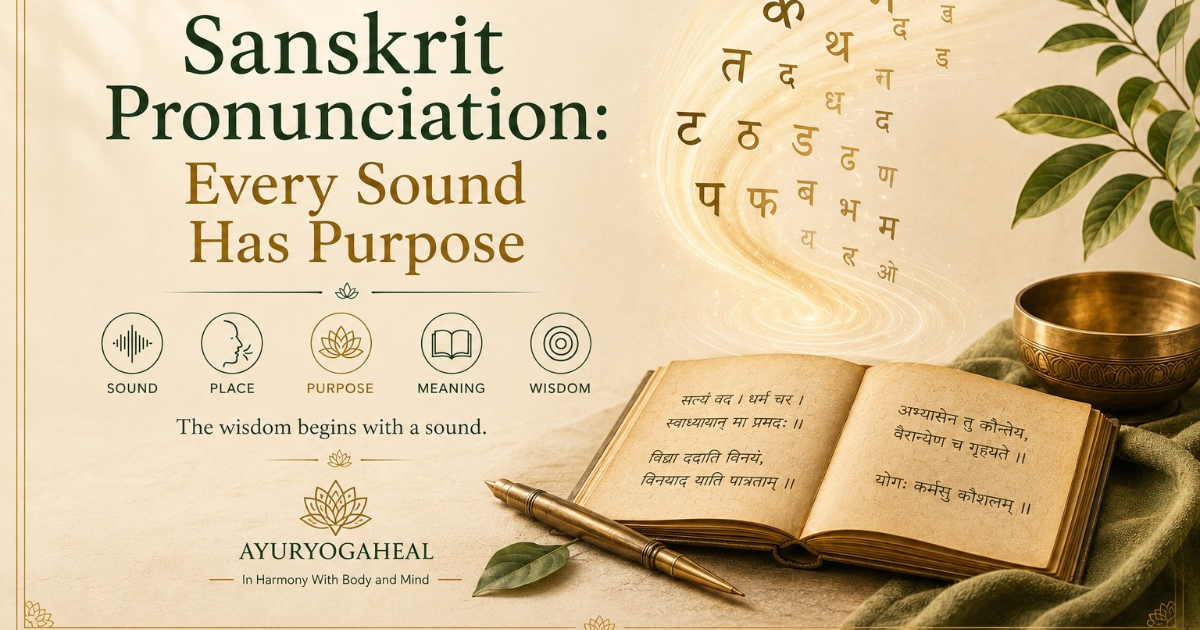
Understanding a Sanskrit word begins not only with its meaning, but also with its sound. Explore how Sanskrit pronunciation is organised and why each sound matters.
Why This Matters
The word Swastha reflects one of Ayurveda’s most important principles: health is not something to chase after—it is something to preserve through balance.
This understanding shapes every aspect of Ayurveda, from daily routines and nutrition to Yoga and seasonal living. Appreciating the meaning of Swastha helps us see why Ayurveda focuses on maintaining health, not simply treating illness.
Why Ayurveda Uses the Word Swastha
Ayurveda did not choose the word Swastha by accident.
It reflects an understanding that health is more than physical well-being.
A person may have normal medical reports yet still feel anxious, exhausted, disconnected, or overwhelmed.
According to Ayurveda, true health exists when body, mind, senses, and inner awareness remain in harmony.
This philosophy is beautifully expressed in one of Ayurveda’s most famous verses.
The Classical Ayurvedic Verse
समदोषः समाग्निश्च समधातु मलक्रियः ।
प्रसन्नात्मेन्द्रियमनः स्वस्थ इत्यभिधीयते ॥
Samadoṣaḥ samāgniśca samadhātu malakriyāḥ ।
Prasannātmendriya manāḥ svastha ityabhidhīyate ॥
— Sushruta Samhita
Translation
A person is called Swastha when:
- the Doshas remain balanced,
- Digestion (Agni) functions well,
- Body tissues are nourished,
- Elimination is proper,
- Mind is peaceful,
- Senses are clear,
- Inner self is content.
The classical Ayurvedic definition of health goes beyond the absence of illness. It describes a state of balance involving the Doshas, digestion, body tissues, elimination, mind, senses, and inner well-being.
What does this complete definition mean in everyday life?
Explore the Ayurvedic Definition of Health to understand each part of this classical verse and how it shapes Ayurveda’s understanding of well-being.
Swastha in Everyday Life
You don’t need to become perfect to move toward Swastha.
Instead, begin with small daily choices.
Ask yourself:
- Do I wake feeling refreshed?
- Is my digestion comfortable?
- Can I concentrate without constant distraction?
- Do I experience moments of calm each day?
- Am I living in rhythm with nature?
These questions reflect the spirit of Swastha more than any fitness score.
Pause & Reflect
Before you continue, take a moment to reflect on your own journey.
What does being truly healthy mean to you?
Is it simply the absence of illness, or does it also include balance, clarity, resilience, and inner peace?
Ayurveda invites us to see Swastha not as a destination to achieve, but as a way of living—one thoughtful choice at a time.
Take the Next Step in Understanding Swastha
Understanding Swastha is the beginning.
Explore the Ayurvedic Definition of Health to discover how Ayurveda describes health through the balance of the body, mind, senses, and inner well-being.
Understand Sanskrit, Don't Just Memorise It
Every Sanskrit word in Ayurveda carries layers of meaning that often disappear in translation. When you understand the language behind the teachings, Yoga and Ayurveda become richer, clearer, and more meaningful.
At Ayuryogaheal, we help students, parents, yoga practitioners, and wellness enthusiasts explore Sanskrit in a simple, practical way—connecting each word with everyday life rather than rote memorisation.
If understanding Swastha has sparked your curiosity about Sanskrit, take the next step. Explore how learning the language can deepen your understanding of the words, verses, and wisdom behind Yoga and Ayurveda.
Tell us what you would like to learn, and we will help you explore a suitable starting point.
Key Takeaways
✔ Swastha means “established in one’s true self.”
✔ It comes from Swa (self) and Stha (established).
✔ Ayurveda uses this word because health includes body, mind, senses, and inner harmony.
✔ Understanding Sanskrit helps reveal the deeper philosophy of Ayurveda.
Frequently Asked Questions
What does Swastha mean in Sanskrit?
Swastha comes from the Sanskrit words Swa (self) and Stha (established), meaning “established in one’s true self.”
What is the difference between Swastha and being healthy?
Being healthy often refers to the absence of illness. Swastha describes a broader state of physical, mental, emotional, and inner balance.
Why is Swastha important in Ayurveda?
Ayurveda uses the word Swastha because it reflects a complete state of harmony rather than focusing only on disease or symptoms.
Why should we learn Sanskrit words in Ayurveda?
Many Ayurvedic concepts lose their depth when translated directly into English. Learning the original Sanskrit meanings helps us better understand the philosophy and practice of Ayurveda.
Is Swastha only a physical state?
No. In Ayurveda, Swastha includes physical balance, mental clarity, emotional stability, healthy senses, and a peaceful inner self.
Conclusion
The Sanskrit word Swastha reminds us that health is not merely something we possess—it is a way of being.
Rooted in the meaning of “being established in one’s true self,” it offers a timeless perspective on well-being: true health arises when body, mind, senses, and inner awareness exist in harmony.
By exploring the original language of Ayurveda, we gain not only new vocabulary but also a deeper understanding of its philosophy—and of what it truly means to live well.
Go Deeper: What Does Health Truly Mean in Ayurveda?
Understanding Swastha is the beginning of a deeper exploration of health.
Ayurveda’s classical definition of health explains how balance in the body’s fundamental principles, digestion, tissues, elimination, and the state of the mind and senses contribute to well-being.
What does this complete definition reveal about living well?
Explore the classical Ayurvedic understanding of health and discover how it extends beyond simply being free from illness.
Explore the Ayurvedic Definition of Health →
Continue exploring other concepts such as Agni, Ama, and Dinacharya as your understanding grows.
Ready to Apply Ayurveda to Your Own Life?
Learning about Ayurveda is the first step. Applying its principles to your unique body, lifestyle, and constitution is where meaningful transformation begins.
If you’re experiencing ongoing health concerns or would like personalised guidance rooted in classical Ayurveda, our certified Ayurvedic doctor offers online consultations tailored to your individual needs, helping you understand your unique constitution and create a personalised path towards lasting health and well-being.